Storage Frame Strength: The Hollow Box Problem
Introduction
When I see “storage sofa” on a tag, I don’t just think about where you will put the blankets. I think about what had to be removed inside the sofa to make that empty box, because that missing structure is usually what keeps a normal sofa from loosening up and getting creaky over time.
The simplest way to picture it is this, a normal sofa frame is like a braced rectangle. It stays square because it has internal cross pieces and reinforced corners that resist twisting when you flop down on one end, sit on the arm, or drag it an inch to vacuum.
To create the storage cavity, the builder has to delete a chunk of that internal framework. I have learned to treat that as a warning sign, not because storage is automatically bad, but because the sofa now has fewer places to spread out stress, and the remaining parts have to work harder.
Here is what I want you to do in the showroom before you fall in love with the fabric. Open the storage compartment and look at how “hollow” the base really is, then close it and put one hand on the arm and one hand on the back and give it a firm twist like you are trying to gently rack it out of square. If you feel the whole body flexing, or you hear clicking, ticking, or wood-on-wood noises, I walk away because that is torsional weakness you will feel more and more once it lives on your floor.
Then I sit on the front edge near one corner, not the middle, because corners are where weak frames show themselves. If the seat dips unevenly, or the opposite side lifts, or the storage lid shifts and rubs, that tells me the frame is not staying rigid under off-center load, which is exactly how real life uses a sofa.
I also look for what they used to compensate for what they removed. If I see thick perimeter rails, solid corner blocking, and hardware that pulls the storage opening tight without wobble, I get more comfortable. If I see thin stapled panels, long unsupported spans, or a lid that depends on flimsy hinges to feel stable, I assume it will get worse, not better, after a year of sitting and opening and closing.
This guide is going to keep coming back to one idea, storage is not free. You are trading internal structure for empty space, so you need to be much pickier about frame stiffness, hinge quality, and how the sofa behaves when you twist it, sit on the corners, and use it like you will at home.
The "Bathtub" Effect
A storage frame is essentially a wooden bathtub, meaning it is a box with tall sides and a thin bottom trying to stay square while you load it from above.The problem starts when the front rail and back rail are not tied together with real cross bracing. In that situation the side walls can flare outward, because the box is being pushed apart instead of being held in a rigid rectangle.
Here is how I test for it in a showroom. I open the storage compartment and look at the long side walls, then I press outward on one wall with my hand like I am trying to widen the opening just a little. If the wall moves easily, or if I can see the bottom panel flex separately from the wall, I assume the box is not getting enough help from internal bracing.
Then I do a real life load test. I sit right on the front edge of the storage chaise, close to a corner, and I let my weight settle for a moment. If the side wall bows outward even slightly, or the lid opening goes out of square and starts to rub, that is the bathtub effect showing itself, because the downward force is trying to spread the walls apart.
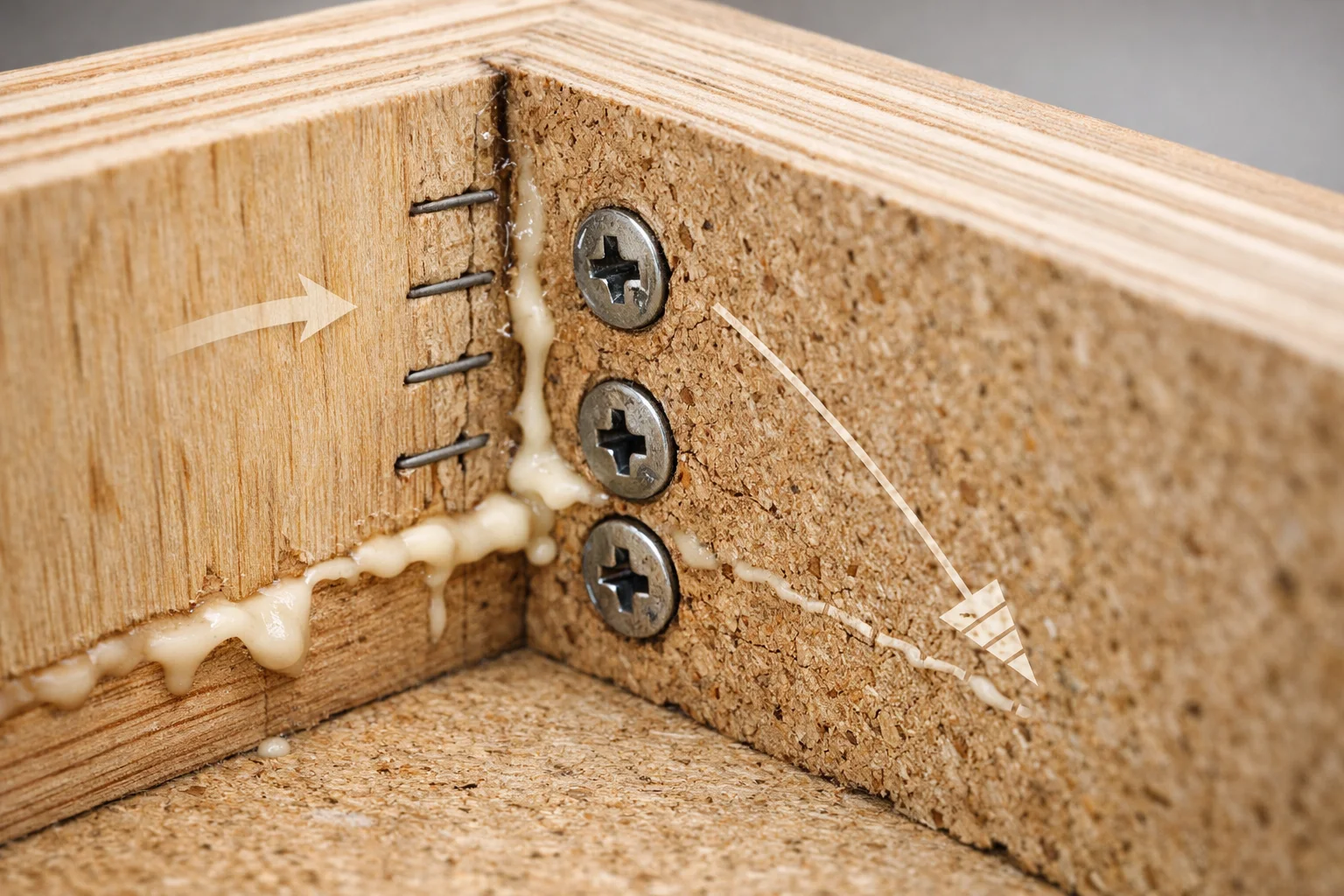
What fails first is usually not the wood itself, it is the fasteners. Over a couple of years of people sitting on the edge, the staples or screws holding the bottom panel to the walls can start to shear or pull out, and that is when the floor of the storage compartment drops down onto your carpet. If you want a quick tell, look at the inside corners where the bottom meets the walls, because if you only see thin panel edges and a line of staples with no blocking, I treat that as a weak connection that is counting on fasteners instead of structure.
If you want to keep shopping without getting technical, ask the salesperson to show you how the storage box is braced. I am listening for an answer that includes real cross pieces tying the front to the back, and I am looking for wood blocking or cleats supporting the bottom panel along the edges. If they cannot show you anything beyond thin panels stapled together, I assume you are buying a box that will slowly spread and sag as soon as it starts getting sat on like a normal seat.
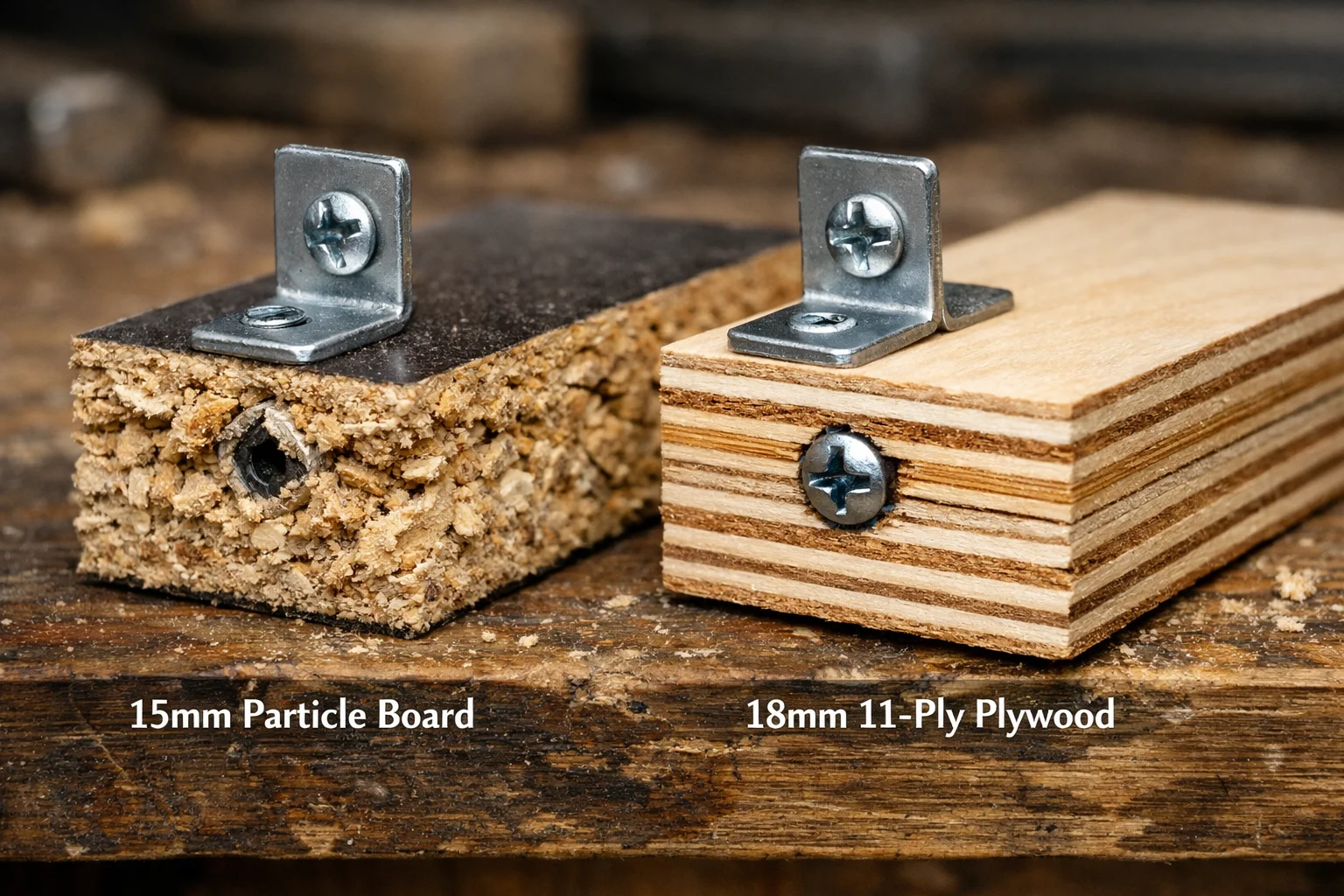
When you are staring into a storage compartment, the bottom panel is the part I obsess over, because it is the part that quietly turns into a hammock when the build is cheap. A sagging floor is not just annoying, it is a clue that the fasteners are slowly losing their grip too.
I want you to look at the raw edge of that bottom panel if you can see it. If it looks like compressed crumbs, or you see a fuzzy brown core under a thin skin, that is usually particle board, and I treat it as a risk in a storage base because screws and staples can work loose when the panel flexes.
If the edge looks like stacked layers of wood veneer, that is plywood, and I breathe easier. Plywood is not magic, but it tends to hold screws better and it resists that long, slow sag that shows up after months of people sitting on the edge and tossing heavy stuff inside.
Here is the showroom test I use that does not require tools. With the storage compartment open, I press down on the floor panel near the middle with my palm and then closer to the front edge, and I pay attention to how it feels and how it sounds. If it flexes easily, or if I hear crackly noises, I assume it will keep moving until the connections loosen.
Then I look at how the floor panel is actually supported. If I can spot wood cleats, blocking, or a ledge that the panel sits on along the sides, that is real support, because the load is being carried by wood, not just by a line of fasteners. If the floor looks like it is simply stapled to the walls with no ledge underneath, I assume the staples are doing all the work, and that is exactly how you end up with a dropped floor later.
If you want one simple question to ask while you are standing there, ask what the storage floor is made of and how it is supported along the edges. I am not listening for fancy words, I am listening for a clear answer that sounds like they have seen the inside of the sofa, not just the outside.
Structural Trade-offs by material
The materials inside a storage sofa matter more than they do in a normal sofa, because you are asking a hollow box to do structural work. When the wrong sheet goods and the wrong reinforcements get used, the failures tend to show up as cracking floors, loosening hardware, and a body that slowly twists out of square.
Particle board vs. plywood
A lot of budget storage sofas, especially flat pack styles, use particle board for the storage box panels and floor. In a showroom it can look perfectly tidy, but over time it behaves like compressed crumbs held together by glue, and that matters because the storage floor is basically a little bridge spanning a wide opening.
If you put heavy things in there, like books, hand weights, or even just a couple dense blankets that always get shoved to the same spot, that floor can crack in the middle or start pulling away where it is attached. What I watch for is not just sag, but separation at the edges, because once the panel starts flexing, the screws and staples start working loose and the box gets noisier and weaker.
When I am trying to buy the “same idea, but built like it expects to be used,” I look for a plywood floor and plywood walls in the storage compartment. If you can see the edge and it looks like multiple thin layers, that is a good sign, because plywood’s cross layers resist bending and tend to hold screws better when the sofa gets opened and closed a lot.
I also ask a very plain question while I am standing there, “Is the storage floor plywood or particle board, and how thick is it.” If the answer is vague, or they dodge and say “engineered wood” without specifics, I assume it is the cheaper option and I adjust my expectations or I keep shopping.
The missing corner blocks
The other material trade off that bites people is not a panel choice, it is what gets left out at the corners. On a traditional sofa, there is usually real wood blocking in the corners that keeps the frame from racking, meaning it resists turning into a slightly skewed shape when you push on it from the side.
On storage sofas, those chunky corner blocks often get omitted to make the storage opening bigger, or they get replaced with thin metal brackets. Metal brackets are not automatically bad, but when they are small and lightly screwed into weak material, they do not stop twist the way a glued and screwed wood block does.
Here is the way I check this without tools. I open the storage compartment, then I put one hand on one front corner of the frame and the other hand on the opposite back corner and I give it a careful twist. I am not trying to break anything, I just want to see if the box stays square. If I feel the corners shifting, or I hear a sharp tick from the joints, I assume the frame is relying on the hinges and the lid to help it stay aligned, and that tends to get worse once it has been dragged around on a rug a few times.
This corner issue shows up later as hardware problems you would never connect to the frame. When the box twists, the lift up hinges can go slightly out of alignment, then the lid starts to rub, then you end up forcing it, and that is when things start jamming or loosening. If I see a storage sofa where the lid already looks like it sits slightly off square when closed, I take that as an early warning that the frame is not staying rigid.
If you want to put a salesperson on the spot in a fair way, ask them to show you what is reinforcing the corners of the storage box. I am looking for an answer where they can actually point to solid wood blocking or substantial internal bracing, not just “it’s got metal supports” with nothing you can really see or verify.
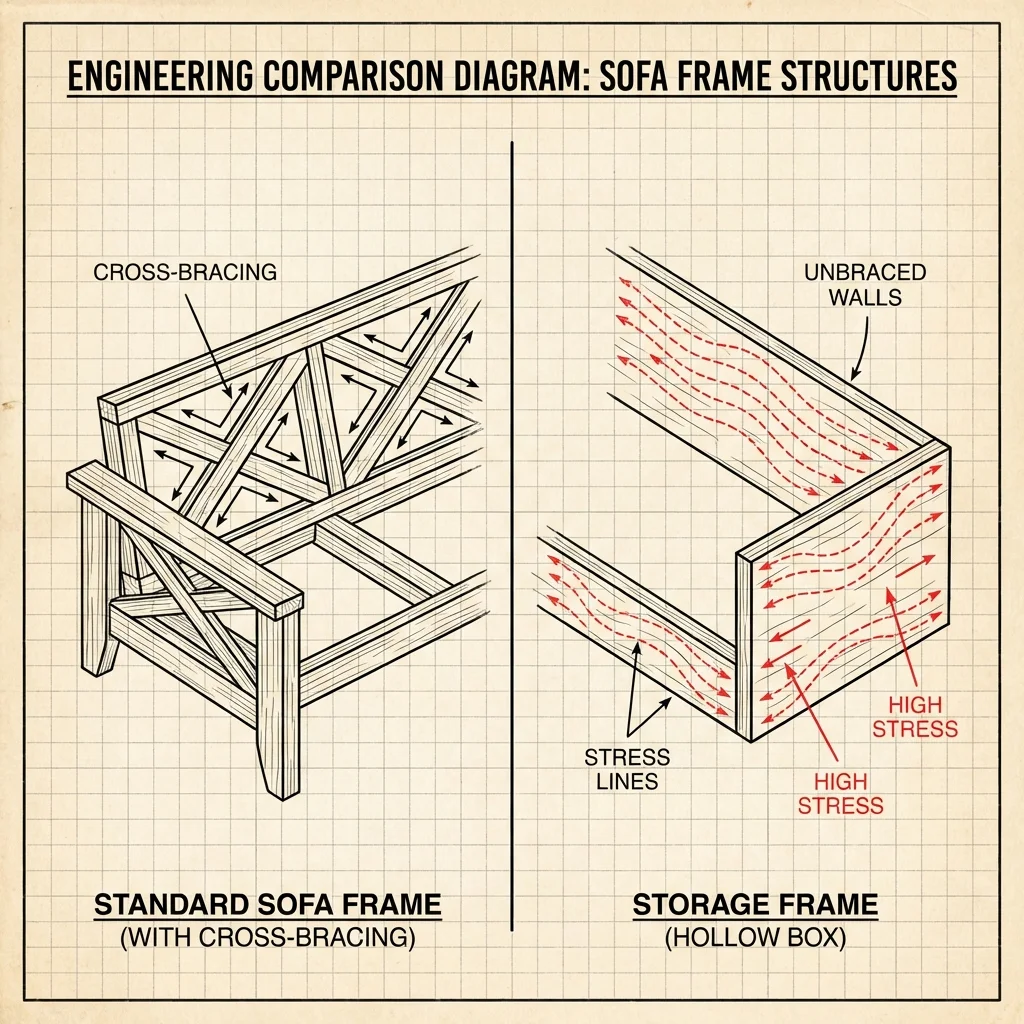
When I look at a diagram like this, I translate it into what you will feel in your hands. Those red zones are the spots where a storage sofa gets that loose, wringing motion when you sit on one end, lean on an arm, or slide it a few inches to clean.
In a showroom, I try to “activate” that twist on purpose. I close the storage lid, put my weight on the seat near one front corner, and at the same time I press sideways on the backrest with my other hand. If the sofa feels like it winds up and then rebounds, instead of staying solid, that is the stress path the diagram is warning about.
Then I open the storage and look for anything that interrupts a big empty rectangle. If all I see is a wide, uninterrupted box, with long side walls and a big open span front to back, I assume the frame has nothing inside it to stop diagonal forces, and you are going to get racking over time.
What I want to see instead is some kind of real tie between the front and the back, even if it is not pretty. If you can spot stout cross pieces, a thick perimeter rail, or corner blocking that looks glued and screwed instead of just stapled, that tells me the frame is at least trying to resist the twisting that storage designs invite.
One more practical tell is the lid itself. If the lid only feels stable when it is fully closed and latched, or it wobbles side to side when it is partway open, I take that as a hint that the lid is being asked to act like a brace, and lids are terrible at that job once the hinges wear even a little.
If you only do one thing with this image in mind, do this. Make yourself sit and push off center, because that is how you will actually use the sofa, then pay attention to whether the box stays square or whether it quietly corkscrews under you.
The "Floor Sag" Prevention
If you use your storage sofa the way a lot of people actually do, meaning you treat it like a hidden trunk for heavy stuff like books, wine, tools, or weights, I assume the original storage floor is going to be the weak link. Even on nicer models, that floor panel is often chosen to keep weight and cost down, not to handle concentrated loads sitting in the same spot for years.What I do at home, and what I would plan to do the moment you buy the sofa, is add a second “skin” to that storage floor. You cut a piece of half inch MDF or plywood to match the inside dimensions of the storage floor as closely as you can, then you simply drop it in so it lies flat. I like plywood when I can get it because it handles flexing better, but MDF works too if it is fully supported and kept dry.
The reason this works is not mysterious, it is just load spreading. A heavy object has a small footprint, so it pushes hard on one spot, and the thin factory floor panel has to bend right there. When you add a second layer, the top layer spreads that pressure outward so the perimeter of the storage box carries more of the load instead of the center of the panel acting like a bridge.
In the showroom, you can even decide whether this is worth planning for. If you press down on the storage floor with your palm and it already has that trampoline feel, I assume you will benefit from the extra layer immediately. If the floor already feels stiff and you can see it is sitting on real ledges or cleats along the sides, you might never need the reinforcement, but I still like the idea if you know you will store dense items.
One practical note I wish someone had told me earlier is to measure twice, because storage boxes are rarely perfectly square. I bring a small tape measure, I measure the width at the front and at the back, and I also measure the depth on the left and right, because some compartments taper a little. If you cut the panel slightly undersized, it will still work, it just will not wedge or rub when the fabric lining shifts.
I also pay attention to what the lid and hinges do with the added thickness. If the lid closes with very tight clearance already, plan on dropping the reinforcement panel on the bottom of the compartment, not stacking it on a little internal lip that raises the “floor” too much. After you add it, the lid should close the same way it did in the store, with no extra force and no new rubbing, because forcing a lid closed is how hinge screws start to loosen over time.
Storage Frame Integrity Standards
When you are comparing two storage sofas that look similar from five feet away, this is where I stop guessing and start judging the box like it is a piece of basic carpentry. The storage compartment is not just a convenience feature, it is a structural cavity, so the thickness and stiffness of those panels matter in the same way a bed frame matters, even if the salesperson wants you to focus on the upholstery.
Side walls are the first thing I check because they act like the “ribs” of the bathtub. When the side walls are thick plywood or solid wood, they fight bowing when you sit on the edge or when the lid gets levered up and down for years. When the side walls are thin MDF or particle board, I assume they will slowly loosen at the fasteners, especially if you ever move the sofa by nudging it from the arm or back.
In the showroom, I open the storage and press on the side wall with my palm midway down, not at the top edge. If it feels springy, or if the wall “oil cans” in and out, I treat that as budget construction even if the outside looks premium. If you can see a raw edge, plywood reads like stacked layers, while MDF and particle board read like a uniform brown core that looks pressed and dusty.
The bottom panel is where I get picky about how it is attached. A screwed down plywood floor usually means the builder expected real load and wanted the connection to stay tight when the panel flexes a little. A stapled hardboard floor usually means the panel is more like a drawer bottom, and I assume it will sag, then the staples will start to complain, then the whole compartment starts sounding like it is full of loose change every time you sit down.
You can often tell how serious the bottom is without measuring anything. I look for visible screws, not just staples, and I look for an actual ledge or cleat under the edges so the floor is sitting on wood support instead of hanging from fasteners. If all you see is a thin sheet tacked to the walls, I assume you are one heavy load away from a permanent belly in the middle.
Corners are the next integrity tell because racking starts there. If the corners are blocked and cinched together with substantial hardware, the box stays square and the lid tends to keep its alignment. If you see small L brackets and a few short screws into weak material, that may feel fine new, but it is the kind of connection that slowly wallows out as the sofa twists during normal use.
My quick check is to look inside the front corners of the storage cavity with a phone flashlight. If you see chunky wood blocking that bridges the two panels and looks like it is meant to resist twisting, that is what I want. If you only see thin metal angles, or you cannot see any real reinforcement beyond the panels meeting, I assume the box will rack more easily, and that usually shows up later as a lid that starts rubbing and hinges that need retightening.
Load rating matters too, but I translate it into one simple habit, I treat storage sofa compartments as “bulk but light” unless the build proves otherwise. If the frame looks professional grade, meaning stout walls, a real plywood floor, and reinforced corners, I am comfortable using it for bedding, seasonal clothes, and a reasonable spread of items. If it looks budget grade, I assume it is more like a place for pillows and throws, and I avoid parking dense weight in one spot.
If you want a real world way to feel this in the store, I do a distributed load test with my hands. I press down with both palms spread apart on the storage floor, then I press with one palm in a single spot, closer to where you would naturally toss something heavy. A better box feels boring and solid both ways, a weaker box feels fine with spread pressure and then suddenly flexy when you concentrate force.
Racking resistance is the final standard, and it is the one that predicts whether the sofa will still feel tight after a couple of years. Steel reinforcement and real cross ties between front and back are what keep the bathtub from turning into a parallelogram over time. If you cannot see any ties, and the walls themselves feel flexible, I assume the sofa will slowly lose that “square” feeling, and once it starts, you cannot really unwear the joints.
If you only ask one question here, I would ask, “Are the storage walls and floor plywood, and is the floor screwed in or stapled.” If the answer is clear and specific, you are at least dealing with a company that expects the inside to be inspected. If the answer is fuzzy, I treat the storage box like it was built to look good in photos, not to live through daily use.
| Component | Professional Grade | Budget Grade |
|---|---|---|
| Sidewall Material | 1.25” Solid Wood / Plywood | 0.75” MDF / Particle Board |
| Bottom Panel | 0.5” Plywood (Screwed) | 0.125” Hardboard (Stapled) |
| Corner Joinery | Blocked and Bolted | L-Brackets and Screws |
| Max Floor Load | 100 lbs (Distributed) | 30 lbs |
| Racking Resistance | High (Steel reinforced) | Low (Flexible walls) |
Explore Technical Reference

Recliner Problems: The 4 Core Mechanical Failures
Understanding why recliners damage walls, tip forward unexpectedly, and
Analyze Details →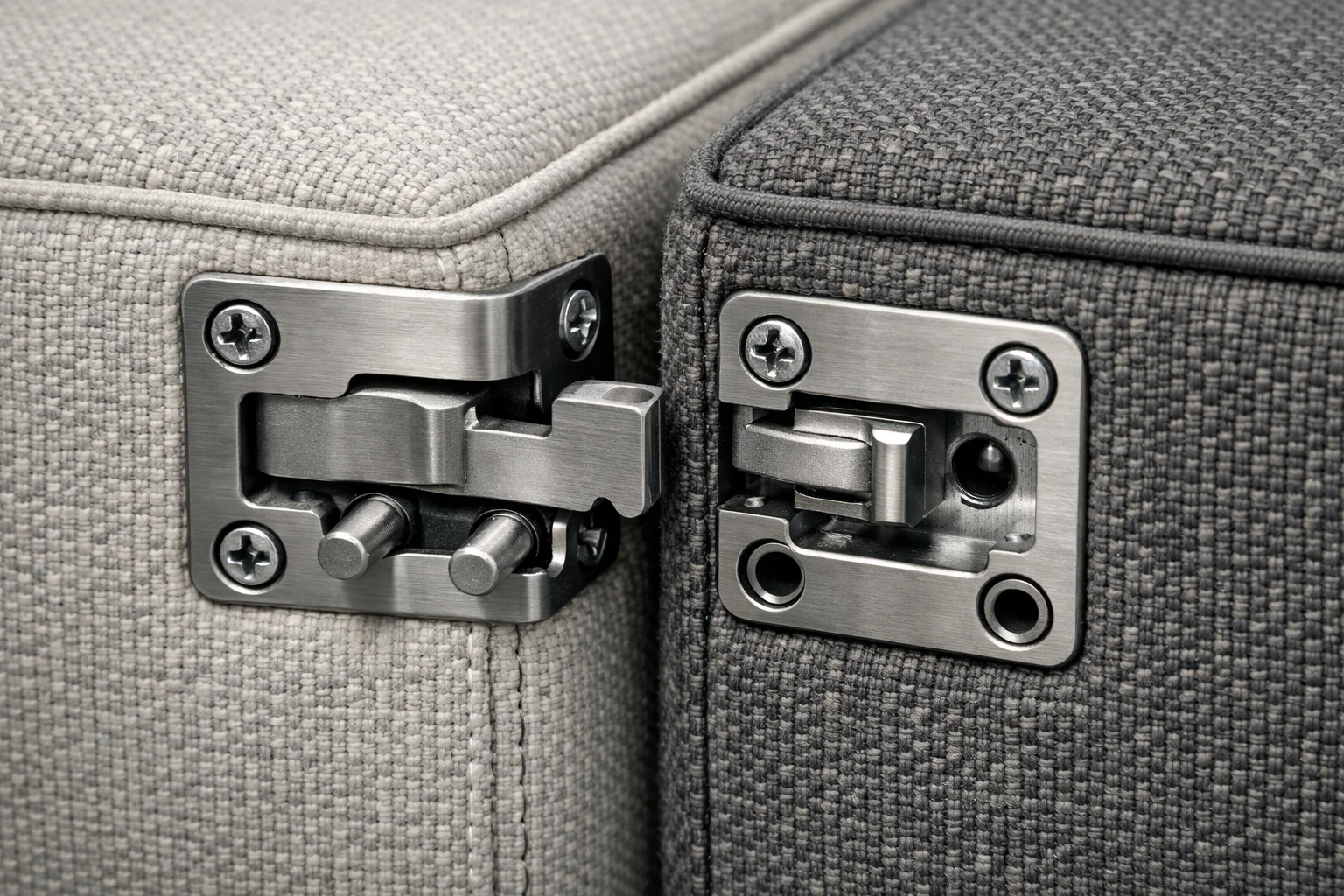
Modular Sofas: The Interchangeability Equation
How true modular sofas differ from traditional sectionals. Understanding connector systems, moving advantages, and the trade-offs that make modular systems cost more.
Analyze Details →