Occasional Use Sofa Beds: The 99% Sitting rule
Introduction
I get why sleeper sofas are tempting. You picture being the kind of person who can say “of course you can stay over,” even if that happens a handful of nights a year.
What I had to learn the hard way is that a sofa is a sitting machine first. In a normal home it gets used almost every day, and the bed part is a rare event.
That’s why I think of most sofa beds as a permanent comfort tax you pay on your regular life. The mechanism takes up space inside the seat, which usually forces thinner cushions, shallower or firmer seating, and more awkward support than a comparable non sleeper sofa at the same price.
So before you fall in love with a pull out, I want you to do one simple reality check in the showroom. Sit on it the way you actually live, feet up, slouched, upright for a conversation, and stay there for a few minutes. If you feel a bar, a ridge, a hard edge under your thighs, or a weird slope that makes you perch instead of settle in, that is the comfort tax, and you will pay it every day.
If your real goal is “I need a real bed sometimes,” I want you to be honest about how often and for whom. If it is a couple of nights a year for a flexible friend, you can often do better with a sofa you truly love plus a separate guest solution like a decent air mattress stored in a closet. If it is regular overnights, someone with back issues, or you live in a studio and this is your main bed, then a sleeper can make sense, but you should shop it like a bed first and a sofa second.
In the rest of this guide, I’m going to help you spot the designs that punish you less on normal sitting comfort, and I’ll show you the showroom checks I use to separate “fine in a quick sit” from “you’ll regret this by month six.”
The "Comfort Tax" Physics
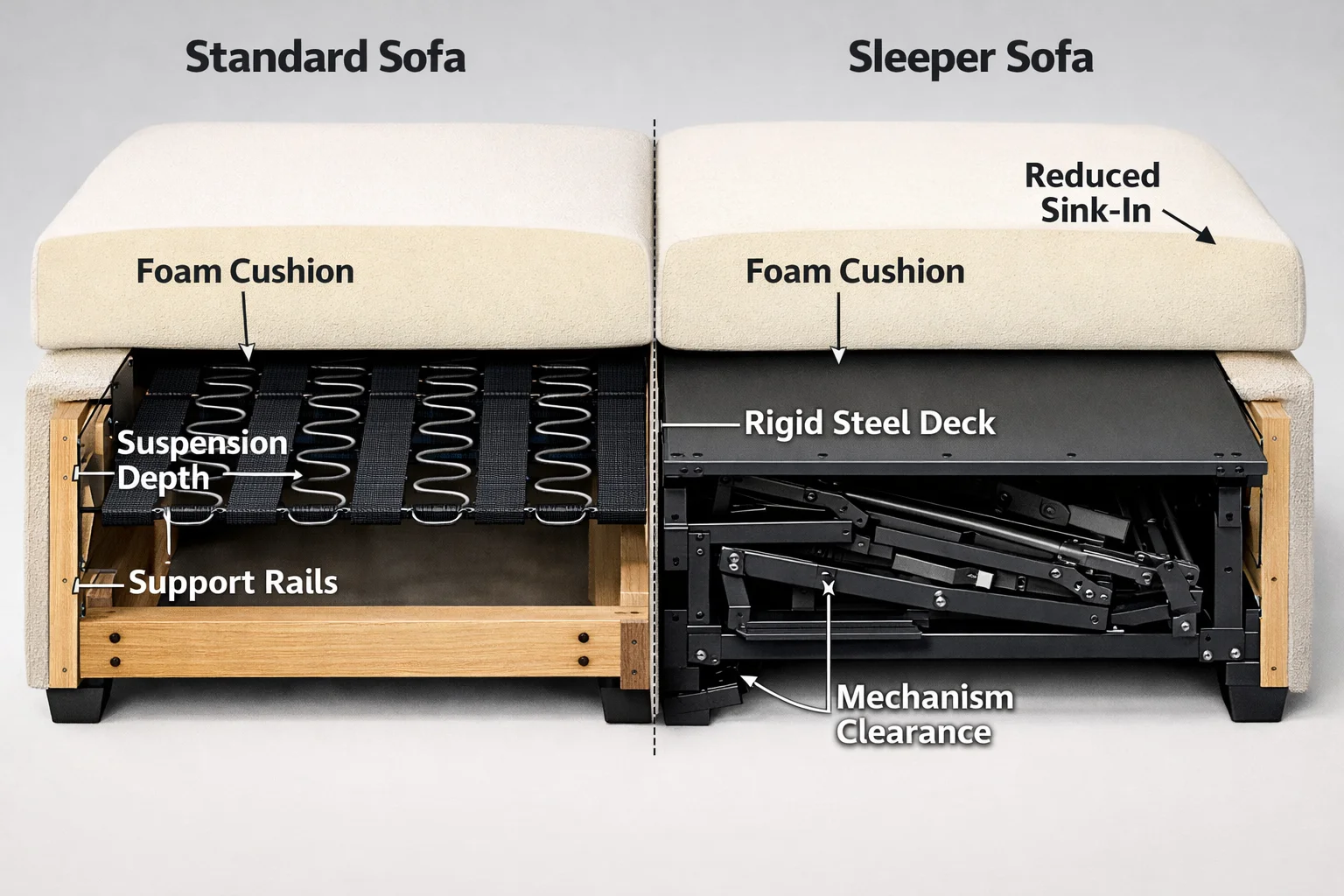
A standard sofa usually has a suspension layer under you, either webbing or springs, and that layer has real depth to it. When you sit, your weight gets shared by that flexible system first, and the cushion is there to fine tune the feel.The conflict with a sleeper is simple, that under seat space is where the folded bed has to live. To make room, the sofa loses most of that deep, forgiving suspension zone.
The result is that the seat cushions are no longer riding on a springy hammock. They are riding on a much more rigid platform, usually a steel deck and the folded mechanism itself, so the cushion has to do almost all the work.
The sensation you feel in the showroom is less sink in and more push back. Even when the foam is expensive, it tends to feel firmer because it is sitting on something that does not give, and on some models you can literally feel like you are perched on a folded metal cage.
This is why I do not let myself get talked into “the cushions will break in.” Foam can relax a bit, but a rigid deck does not magically become a spring system later.
In the showroom, I want you to test for the deck, not just the cushion. Sit down normally, then shift your hips forward a few inches, then back into the corner, and notice whether the feel changes from cushy to board like depending on where you land.
Now slide your hand, palm down, between the front edge of the seat cushion and the frame. If you feel a hard lip right under the cushion, that is often the front rail or part of the mechanism, and it is a common source of that under thigh pressure that shows up after a longer sit.
I also do a quick “one cheek” test, I sit slightly off center and see if the sofa still feels supportive or if it suddenly reveals a ridge or a hinge line. If you can feel the architecture of the bed through the seat during a casual shift, you will feel it even more when you are tired at home.
The last check is the one that surprised me the most when I first started paying attention. I put my feet on the floor like I am eating or working, then I pull my feet back under me. If the front edge starts biting into your thighs as soon as your knees bend more, that is often the rigid deck plus a too thin cushion, and it is the kind of annoyance you cannot un notice once you own it.
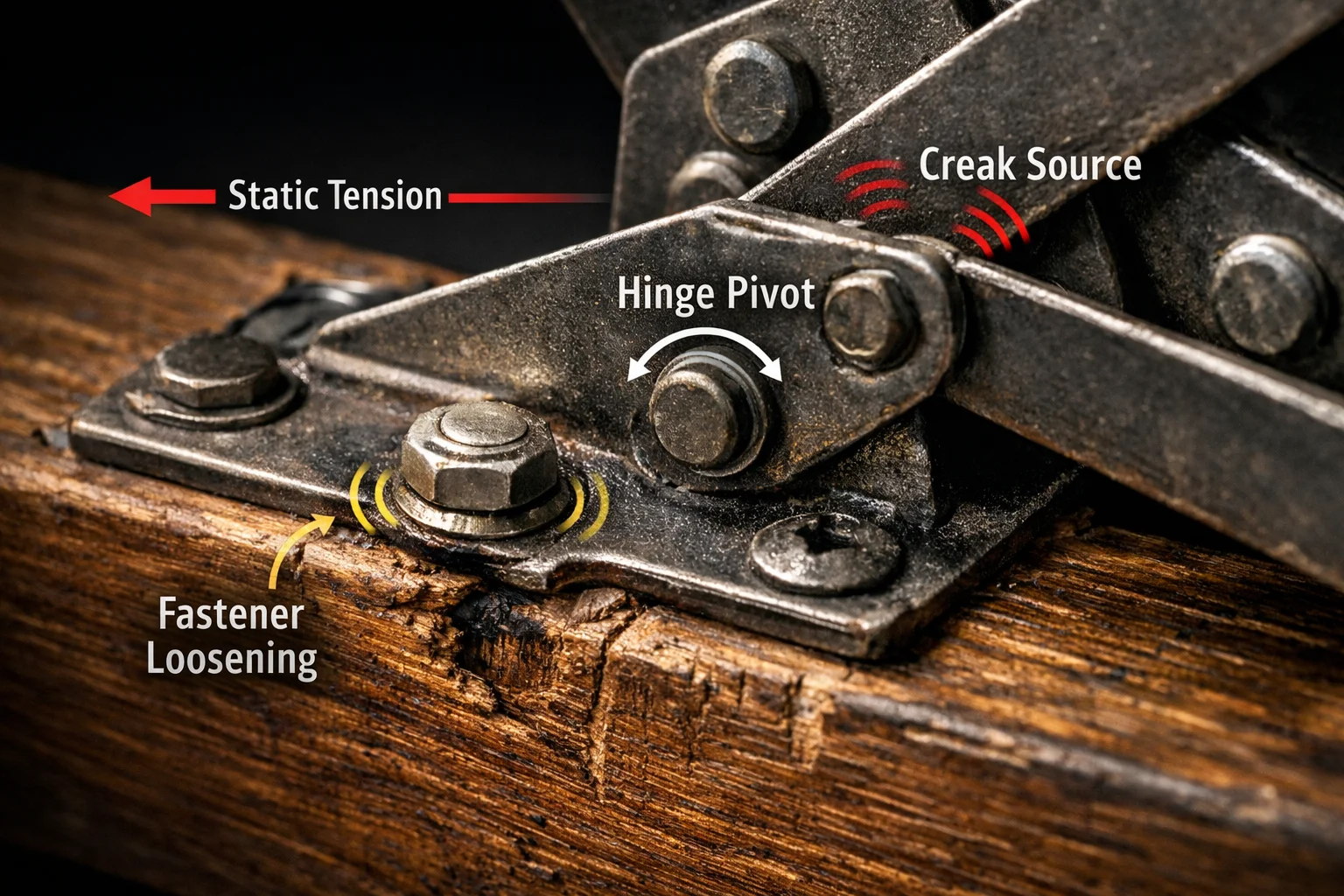
When you look at a sleeper mechanism up close, what jumps out to me is that it is not just “there when you need it.” It is a folded machine living under the seat, and a lot of it stays under some level of tension even when the bed is closed, which means the same few hinge points and fasteners get stressed every single time someone sits down.
In the showroom, I want you to treat the mechanism like a wear item, because that is what it is. You are not only judging how it opens today, you are judging whether it will still feel tight and aligned after years of people dropping onto the sofa.
Ask the salesperson to open it, then you do it yourself too. If they refuse, or only they are “allowed,” I take that as a bad sign because you are the one who will be operating it at home, and a mechanism that is fussy in a controlled showroom is usually worse in real life.
As you pull it out, pay attention to whether it racks, meaning one side gets ahead of the other. If you feel twisting, scraping, or a moment where you have to yank to get past a sticky spot, I assume that is where wear will concentrate, and I move on unless the rest of the sofa is truly exceptional.
Once it is open, I put one hand on each side rail and give it a gentle side to side wiggle. I am not trying to break it, I am checking whether it feels like a solid rectangle or like a loose ladder, because looseness is what turns into squeaks and sag over time.
Then I look right at the hinge areas and the points where bolts go through slots. If you can already see shiny rub marks, little flakes of metal dust, or elongated looking holes, that tells me parts are already shifting against each other, and that usually gets worse once it is a daily seat.
Before you close it, I do one more practical test that matters more than most people think. I fold it back in and listen for clacks or pinging sounds, then I sit back down and see if the seat feel changed compared to before we opened it, because a mechanism that settles differently each time can make the sofa feel inconsistent from day to day.
If you want a sleeper but you also want it to stay pleasant as a sofa, I have learned to favor designs where the seat still has some real suspension and depth above the mechanism. In the showroom that usually shows up as a seat that feels evenly supportive across the width, without that telltale hinge line you can map with your hips.
The Frequency Math
This is the part where I stop thinking about mechanisms and start thinking about your calendar. Before you pay for the sleeper upgrade, I want you to do a quick “Guest Audit” of the last 24 months, not the life you imagine, the life you actually lived.
I literally mean you should think back through holidays, birthdays, work trips, visits from family, and those random weekends when someone crashed on your couch. Add up how many nights someone actually needed a place to sleep in your home, then divide by two to get a realistic year.
If you are landing at something like a dozen nights a year or more, the integrated mechanism starts to make sense as a convenience. At that frequency, you are not just buying an occasional trick, you are buying a feature you will genuinely use, and the hassle of hauling out an air mattress and finding bedding over and over gets old.
But if your honest number is more like three nights a year, the math flips. In that situation, you are typically paying a big premium for the sleeper version, and you are accepting worse everyday sitting comfort so you can solve a problem that shows up for a long weekend.
When I frame it that way in a showroom, it changes how I shop. I stop asking “is it nice that it pulls out,” and I start asking “would I still buy this exact sofa if the bed part never got used.” If the answer is no, I treat the sleeper feature as a distraction, because you will be living with the sofa part far more than the bed part.
There is also a people factor that matters as much as the night count. If your guests are younger, flexible, and you are hosting one person at a time, you can usually cover those rare nights with a separate setup without sacrificing your daily seat. If your guests are older, have back issues, or you routinely host a couple who expects a real mattress feel, then a sleeper that is genuinely comfortable as a bed becomes less of a luxury and more of a requirement.
The way I keep myself honest is I imagine the next year, not the ideal one, the likely one. If you can only picture the sleeper being used on Thanksgiving and maybe one other weekend, I would rather see you put that extra money into a better non sleeper sofa you love sitting on, then solve the guest nights with something stored in a closet, because that choice improves your everyday life instead of taxing it.
The True Cost of Integration
The sleeper upgrade is not a small add on, it is usually a real chunk of the purchase price. In the ranges I keep seeing, the mechanism commonly adds about $600 to $1,200, and what bothers me is how often that money does not buy you a better sofa, it just buys you the ability to turn it into a bed.
In a showroom, I like to do a simple comparison that salespeople rarely volunteer. I ask what the exact same sofa costs in a non sleeper version, or I ask to be shown a non sleeper sofa from the same brand at the sleeper’s price point, then I sit on that one too. If the non sleeper at that price suddenly feels more comfortable, more supportive, and better finished, that is your missing value right there.
The weight is the next hidden cost, and it is not abstract. A sleeper is often 100 pounds or more heavier than a standard sofa, and that changes your life the first time you move, rearrange, or even try to get it through a hallway.
If you live in an apartment, I want you to think through the whole path right now, not later when you are sweaty and stuck. Measure your doorways and the tightest turn in your hall, and ask the store for the boxed or wrapped dimensions, not just the sofa’s “overall” size, because sleepers are less forgiving when you have to tip and pivot.
Then ask about delivery and future service like you expect a real problem someday, because with a heavy mechanism, you probably will. If they are pushing curbside delivery, or they will not talk clearly about what happens if it needs warranty work inside your home, I treat that as part of the price, because you are the one who will pay for muscle later.
I also want you to be honest about your own habits. If you are the kind of person who likes to reconfigure a room, or you move every couple of years, the sleeper’s weight and awkwardness is a tax you pay repeatedly, not once.
The last cost is the one that sneaks up on you slowly, and it is why some sleepers sound “old” early. The bed frame is not just sitting there peacefully under the seat, it is a folded assembly that stays under static tension from the way the mattress folds and presses on the frame, and that constant load can encourage creaks and little shifts over time.
In the showroom, I try to “hear the future” by doing a quiet test. I sit down, shift my weight side to side, then stand up and sit down again, and I listen for any tick, chirp, or metallic creak that repeats in the same spot. If it is already making noise on a clean floor in a quiet store, I assume it will be worse on my subfloor at home.
I also put my hand on the arm or the back while I sit and move a little, because you can sometimes feel vibration travel through the frame when something is loose. If the sofa feels like a single solid piece, that is what you want, but if it feels like the seat is doing one thing and the arms are doing another, I get cautious fast.
If you still want the integration, I think the right mindset is to pay for it on purpose. I want you to treat that $600 to $1,200 premium as money that must buy you a sleeper that is genuinely easy to live with, not just one that technically opens, and I want you to treat any early noise, twisting, or fussiness as a preview, not a quirk you will somehow stop noticing.
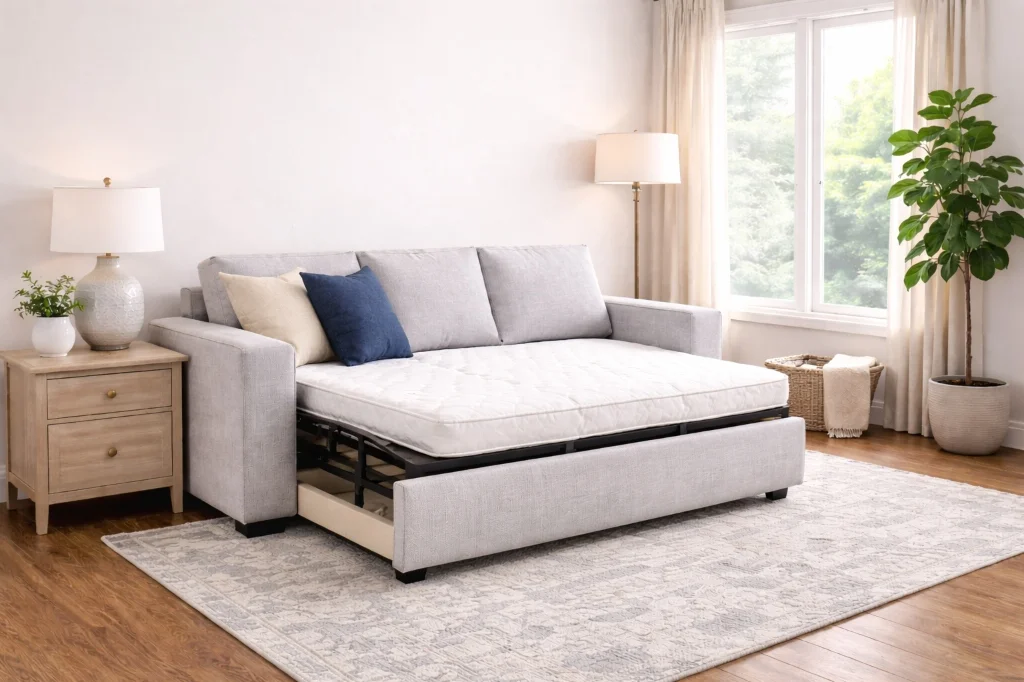
That pie chart is the trap I’ve watched myself fall into, and I’ve watched sales floors encourage it. The moment you imagine a guest sleeping over, it becomes weirdly easy to accept a sofa that you do not actually enjoy sitting on.
In the showroom, I want you to flip the burden of proof. Instead of asking “does it make a decent bed,” ask “would I be happy with this as my only sofa even if nobody ever slept on it.”
If you feel even slightly unsure, do a simple side by side reality check before you buy. Sit on a similarly sized non sleeper sofa in the same store, at roughly the same total price, and pay attention to how quickly your body relaxes on the non sleeper compared to the sleeper.
What I notice almost every time is that the non sleeper lets your hips settle without you hunting for a sweet spot. If the sleeper makes you micro adjust, perch, or keep shifting to avoid a pressure point, that is your daily life, and the occasional overnight does not magically compensate for it.
This is also where I stop letting “guest friendliness” bully me. If you host rarely, the kindest thing you can do for yourself is buy the sofa you actually want to live on, then solve the sleep problem separately in a way that does not tax your back, your thighs, and your patience every single day.
If you host often, I still want you to respect the 99 percent. You can pick a sleeper, but you should insist on one where the sitting comfort holds up under a longer test, not the quick polite sit that makes anything feel fine for thirty seconds.
My personal rule in a showroom is that I do not decide right after I pull the bed out and admire the trick. I decide after I’ve sat on it again, in the exact posture I use at home, and asked myself whether I would be annoyed by this seat on a random Tuesday night when nobody is visiting.
The “Air-Mattress + Premium Sofa” Alternative
The "Air-Mattress + Premium Sofa" Alternative
When I am on the fence, this is the alternative that keeps me from overpaying for a mediocre sleeper. I separate the functions on purpose, meaning I buy the best static sofa I can afford for everyday sitting, then I handle the rare sleeping nights with a raised, higher end air mattress that lives in a closet.What this does in real life is simple. Instead of spending something like $2,500 on a sleeper sofa that asks you to accept thinner cushions and a more rigid deck, you can put most of that budget into a genuinely comfortable, better built sofa, then spend the remainder on a guest bed that is not limited by a thin folding foam slab.
The win is that you stop paying the comfort tax for roughly 362 days a year. You get a sofa that feels like it was designed to be sat on, and your guest gets a dedicated sleep surface that can be thicker and flatter than what most pull outs can hide inside a frame.
If you try this route, I want you to shop the sofa like the bed feature does not exist at all. In the showroom, I sit longer than feels polite and I pay attention to whether the seat stays comfortable when I stop “testing” and start relaxing, because that is the whole point of this strategy.
Then I treat the air mattress as its own purchase, not a bargain bin accessory. I look for a raised style so your guest is not climbing off the floor, and I care a lot about how stable it feels when you roll over, because the cheapest ones feel like a wobbly pool toy at 3 a.m.
The easiest showroom level reality check is to picture where it will live and how annoying it will be to deploy. If you do not have a closet that can hold the rolled mattress and a bedding tote, or you already hate clutter, you might decide the convenience of a sleeper is worth the everyday comfort hit, and at least you are making that trade with your eyes open.
I also want you to think about the guest experience honestly, because the air mattress plan works best when you can give it a decent “bed zone.” If your living room layout forces the mattress to block the only bathroom path, or you cannot dim the room, a sleeper can feel more civilized simply because it keeps the footprint smaller.
When this alternative really shines is when you are already looking at a sleeper in a showroom and you feel that familiar hint of perching, thigh pressure, or that board like deck under the cushion. In that moment, I mentally reprice the sofa as “sofa only,” and if it is not winning on comfort right now, I would rather take the same money and buy a sofa that is actually great at the thing it will do every day.
If you are worried this makes you a “bad host,” I think the opposite is usually true. A great sofa plus a genuinely decent air mattress is often more comfortable for your guest than an average sleeper mattress, and it lets you keep your living room sofa from being a compromise piece you secretly dislike.
Decision Matrix: Integrated vs. Detached Bed
When I am stuck choosing, I stop arguing with myself in abstract terms and I run this like a trade, because you cannot get every benefit at once. An integrated sleeper is about speed and footprint, and a detached guest bed is about protecting your everyday sitting comfort and keeping the sleep surface replaceable.
On daily sitting, I assume the integrated sleeper will feel firmer and a bit shallower because there is a mechanism living under you, and the seat has less forgiving suspension depth to work with. With a normal static sofa, your seat is usually deeper and more responsive because the webbing or springs can actually do their job under the cushions, and that difference shows up after twenty minutes, not just in a quick showroom sit.
On guest setup, this is where the sleeper wins, and it is not subtle. If you know you will be the one hosting often, and you value a two minute “pull, unfold, done” routine, the integrated bed is the convenience purchase, even if the mattress is only decent. With an air mattress setup, I mentally budget closer to ten minutes in real life once you factor in finding the pump, clearing the floor, inflating, and then dealing with bedding.
On weight and portability, I treat sleepers as a commitment, not a flexible piece of furniture. A lot of them are extremely heavy, sometimes in the 250 pound range or higher, and that matters when you move, when you need service, and even when you just want to slide the sofa to vacuum. A static sofa is usually far easier to live with, and even if it is not “light,” it is typically a normal two person move instead of a dreaded event.
On storage, the sleeper is storage free because the bed lives inside it, which is the whole point, but you pay for that in seating architecture. The detached bed plan needs closet space, because you are storing the mattress and usually a bedding tote, so I want you to be honest about whether you truly have a place for it that will not turn into constant clutter.
On comfort lifetime, this is one of my biggest deciding factors because it is where people get quietly disappointed. Sleeper mattresses tend to sag or get lumpy in a way you cannot really fix without replacing a weird, specific size, and that can show up around the five year mark even if the sofa itself still looks fine. With a static sofa plus a separate mattress, the guest bed is a consumable you can replace whenever it stops performing, and your sofa does not have to take the blame for it.
On floor stress, I have learned to think about the building, not just the furniture. A heavy sleeper concentrates weight and can transmit more vibration when people sit down hard, shift around, or when the mechanism has a little looseness, and older floors complain about that first. A standard sofa with a separate air mattress tends to be gentler on the floor day to day, and when the guest bed is out, the load is spread differently and temporarily.
If you want me to translate this into a fast showroom decision, here is what I do. If the integrated sleeper does not feel good as a sofa within five minutes, I do not try to talk myself into it, because that discomfort will show up hundreds of times between guest visits. If you sit down and immediately relax, and the mechanism passes the twist and noise tests you already did, then the convenience can be worth paying for.
If you are leaning detached, I want you to do one unglamorous check before you leave the store, which is to picture the exact rectangle of floor the air mattress would occupy and the walking path around it. If that mental picture feels chaotic, like it blocks the bathroom or the only route to the kitchen, that is when the integrated sleeper earns its keep even if it is not your dream sofa.