Recliner Foam: The Apex Stress Problem
Introduction
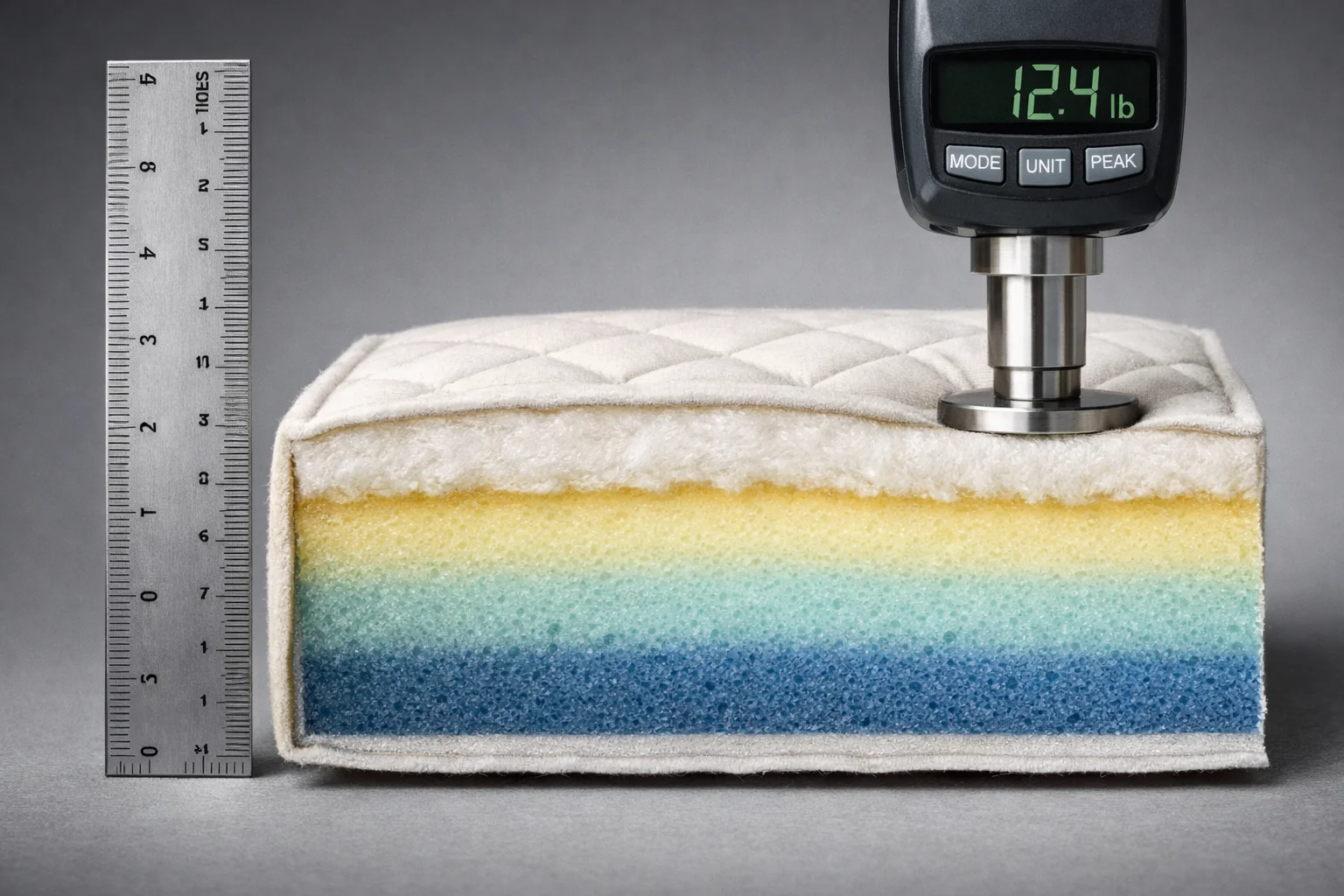
A recliner is the quickest way I know to expose cheap foam, because it loads the seat in a way most sofas never do. When you sit on a normal sofa, your weight spreads out across your thighs and glutes, and even mediocre cushions can seem fine for a few minutes.
When you open a recliner, that changes fast. As your feet go up and your head goes back, your body slides into one main pressure point, and it ends up concentrating a lot of your weight right under your tailbone on a small patch of foam. I think of that spot as the gravity apex, because if the foam is going to quit, it usually quits there first.
What I want you to do with that idea in mind is use the recliner like a test bench in the showroom. Do not just perch on the edge and say it feels soft. Sit all the way back, open it fully, and stay there long enough for the foam to show its real personality.
Pay attention to whether the cushion keeps holding you up or whether you slowly sink until you feel a hard layer underneath. If you feel the frame, the platform, a bar, or anything that reads as a firm ridge under your tailbone, I take that as a warning that the foam is either too soft, too thin, or already compressing.
Then close it and stand up, and look at the seat. I always watch to see if the cushion rebounds quickly and evenly or if it stays dished where I was sitting. A little imprint is normal, but a deep crater that lingers tells me the foam is losing the fight already, and that is exactly how recliners end up feeling “worn out” long before the fabric looks worn.
If you are shopping with someone else, have them sit in the recliner after you, because back to back sits reveal a lot. When the first person leaves a dip that the second person immediately falls into, I assume the cushion will develop a permanent tailbone hole at home, and you will be trying to fix it with throws and extra pillows within a year or two.
The point of starting with this is simple. If a recliner can stay supportive at the gravity apex, a normal sofa seat has a much easier job, and you are less likely to end up disappointed later.
The ‘Hole’ in the Seat
The "Hole" in the Seat
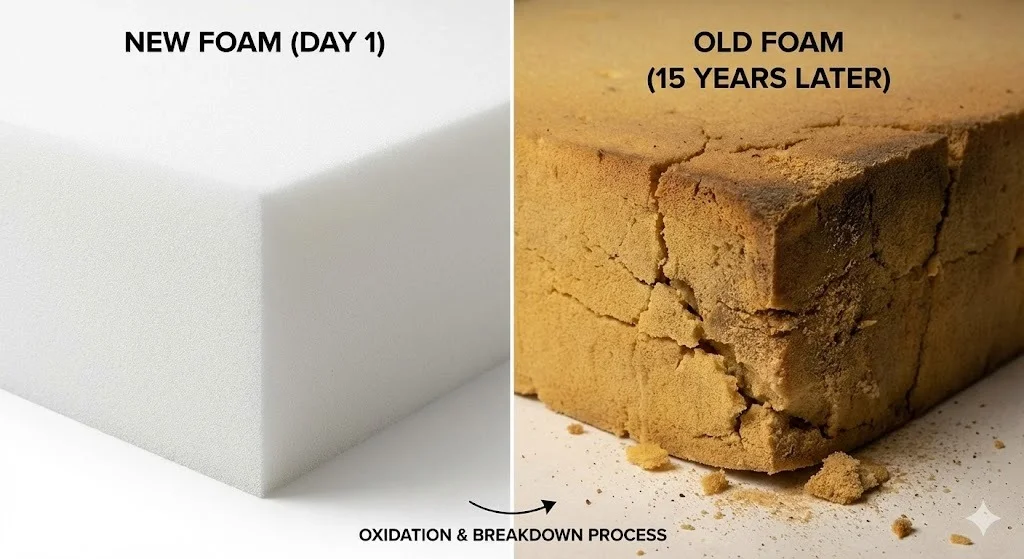
When I see a recliner built with the standard “average sofa” foam, usually around 1.8 pound density polyurethane, I assume the seat is on a clock. In a recliner, that gravity apex under your tailbone is so punishing that this kind of foam often turns into a permanent divot in about a year to a year and a half of normal use.What is happening is something I watch for because it feels like a betrayal when it shows up at home. The foam takes a compression set, which is a fancy way of saying the foam cells get crushed and do not spring back, especially when the pressure is concentrated in one small spot over and over.
The practical result is that you stop sitting on cushion and start sitting on whatever is underneath it. In a recliner that usually means you begin to feel the steel mechanism, a bar, or the hard deck, and once you can feel that through the cushion, the “hole” tends to get worse rather than better.
In the showroom, I do not let anyone hand wave this away as “it will break in.” Breaking in should feel like the cushion relaxing a little while still holding you up, not like your tailbone finding a hidden metal part.
What I do is a very plain reality check. I fully recline, scoot my hips to where I would actually lounge at home, and I stay put long enough that the foam warms up and settles, because some cushions feel supportive for the first minute and then collapse.
Then I close the recliner and look at the seat from the side, not just straight on. If I can still see a dish in the exact spot where my tailbone was, or the fabric looks slightly “pulled” into a crater, I treat that as an early warning of compression set.
If you want to push a little harder without getting technical, ask the salesperson what the seat foam density is and whether the recliner seat has any extra reinforcement under the main sitting zone. If they cannot tell you anything beyond “high density” or “premium foam,” I assume you are buying blind, and I get more skeptical about that gravity apex holding up over time.
I also pay attention to thickness in a very simple way. If the cushion looks slim and I can feel anything firm underneath even when the recliner is brand new, I assume there is not enough foam there to sacrifice over time, and that is how you end up “bottoming out” early even if the fabric and stitching still look perfect.
If you love the chair anyway, the best thing you can do is make the seat prove itself before you commit. You want to feel held up in that reclined tailbone spot, then you want to see the cushion come back close to flat within a short time after you stand, because that rebound is the closest preview you get of whether the seat will stay a seat, or turn into a hole.
The Three Stress Zones of a Recliner
When I evaluate a recliner, I stop thinking of it as “a chair” and start thinking of it as three separate wear problems stacked together. The seat gets hammered straight down, the back gets torqued as you lean and shift, and the footrest takes a constant levering force from your legs.
If you only do one quick sit in the showroom, you miss two of those zones almost completely. I want you to test all three on purpose, because a recliner can feel great for five minutes and still be built in a way that loosens, sags, or clunks once the easy parts break in.
The first stress zone is the seat, especially that gravity apex under your tailbone that I already had you focus on. Here I care less about “soft” and more about whether the cushion keeps you floating above the hard stuff when you are fully reclined and relaxed.
What I do in the showroom is plant myself the way I actually lounge at home, then I make small shifts like I am watching a movie, sliding my hips a bit and settling again. If a cushion is going to give up, those little movements often make it happen, and you will feel yourself drop into the same spot like the chair is trying to remember you.
The second stress zone is the back, and this is where a lot of recliners quietly fail without ever looking torn or broken. When you recline, your back is not just pushing straight back, it is also twisting the frame a little, because most people lean slightly to one side, reach for a drink, or prop an elbow.
I test this by reclining to a comfortable position, then pressing my shoulders into the back while I gently shift my torso left and right. I am not trying to be rough, I am trying to see if the back feels like a single solid panel or if it feels like a loose ladder that racks and flexes.
If I hear clicking, feel a delayed wobble, or notice the back “catch” and then move, I assume the joints and fasteners are already close to their tolerance limit. A good back feels boring in the best way, it moves smoothly, stays quiet, and does not feel like it is steering on a hinge behind your ribs.
I also pay attention to head and neck support in a very practical way. If the headrest only feels right when I sit perfectly still, I assume I will spend real life pushing my head forward and gradually slumping, which increases strain on the back frame and makes the chair feel less supportive over time.
The third stress zone is the footrest and the mechanism that holds it. This is where I see “looks fine” recliners turn into noisy, loose recliners, because the footrest is basically a lever, and your legs keep loading it every time you extend, shift, and retract.
In the showroom, I extend the footrest, then I rest my heels the way I naturally would, and I lightly press down and release a few times. I am listening and feeling for looseness, like a little dip before it resists, or a side to side wiggle that makes the footrest feel like a tray table instead of a support.
Then I bring the footrest back in and send it out again more than once. If the mechanism feels smooth the first time but rough the second time, or if it starts to clack as it seats, I take that seriously, because mechanisms do not usually get quieter with age.
If the recliner is a push back style, I pay extra attention to how hard it is to close. If I have to throw my body forward to get it to latch, I assume that closing force is going to translate into wear at the same points, and you will eventually feel slop in the action, even if nothing technically “breaks.”
One more thing I always do is check whether the stress zones feel connected in a bad way. If I can feel the footrest movement telegraph into the seat, or the back movement makes the whole chair shift on the floor, I assume the frame is flexing instead of the mechanism doing its job.
You do not need to diagnose the engineering to protect yourself. You just need to notice whether each zone feels solid on its own, and whether the chair stays quiet and supportive when you combine them by reclining fully, shifting around, and cycling it a few times like you will at home.
If you find a recliner that passes the seat test but feels loose in the back or footrest, I treat that like a long term comfort problem hiding behind a short term cushion feel. In my experience, the first clunk and the first little wobble are the beginning of the story, not the end of it.
1. The Tailbone Apex (Seat Hinge)
This is the highest stress point in the whole chair, and it is the spot I trust the least on a recliner that “feels plush” in the showroom. When you recline, gravity slides you into the V where the seat meets the back, and your tailbone ends up asking a small patch of foam to do an unfair amount of work.
In practical terms, this is why a recliner can feel supportive when you sit upright, then feel like it develops a hard ridge the moment you lean back and relax. You are not imagining it, you are just moving your weight onto the hinge zone where the cushion is most likely to thin out first.
If you only do one test in the store, do it right here. I recline to the position I would actually use at home, then I deliberately scoot my hips until I can feel myself settle into that seam area, and I stay there. If the chair is going to create a tailbone divot, this is where it starts, and it often shows up after a couple minutes, not the first ten seconds.
What you want is a held up feeling, like the foam is pushing back evenly instead of folding. What I do not want you to feel is a sharp change in support right at the seat back junction, like the cushion suddenly stops and you drop onto something firmer underneath.
This is also the one time I stop being shy about asking a direct materials question, because the hinge zone needs better foam than the average sofa seat. I ask, “Is the seat foam high resilience foam, and what is the density?” If you get a clear answer like HR foam around 2.2 pounds density or higher, I take that as a good sign that the maker at least designed for this problem.
If you get vague language like “high density,” “premium,” or “comfort foam,” I assume it could be ordinary polyurethane that will feel fine early and then take a set in that hinge pocket. I am not trying to win an argument with the salesperson, I just want a real spec because that is the only easy way to separate a hinge zone built for concentrated load from one built for a quick sit test.
There is a simple physical check you can do even if nobody can tell you the foam type. While you are reclined, slide one hand down beside your hip and press into the cushion right at the hinge seam, then press a few inches forward on the flatter part of the seat. If the hinge area feels noticeably thinner, or you hit a firm layer sooner right at the seam, I assume you will feel that spot more and more once the foam breaks down.
After you stand up, look closely at that exact junction. I am not just checking for a general imprint, I am checking whether the deepest dish is right at the seat back meeting point. When that hinge pocket holds the deepest crater, it usually means that is where the foam is getting overwhelmed, and that is the place you cannot “fluff” back into shape later.
If you love everything else about the recliner but this zone feels borderline, I would rather you size up the cushion feel than size down. In my experience, a slightly firmer seat that keeps your tailbone floating in the hinge is the one that still feels comfortable a couple years in, while a soft seat that lets you settle into that V tends to turn into a permanent low spot that no throw pillow can fix.
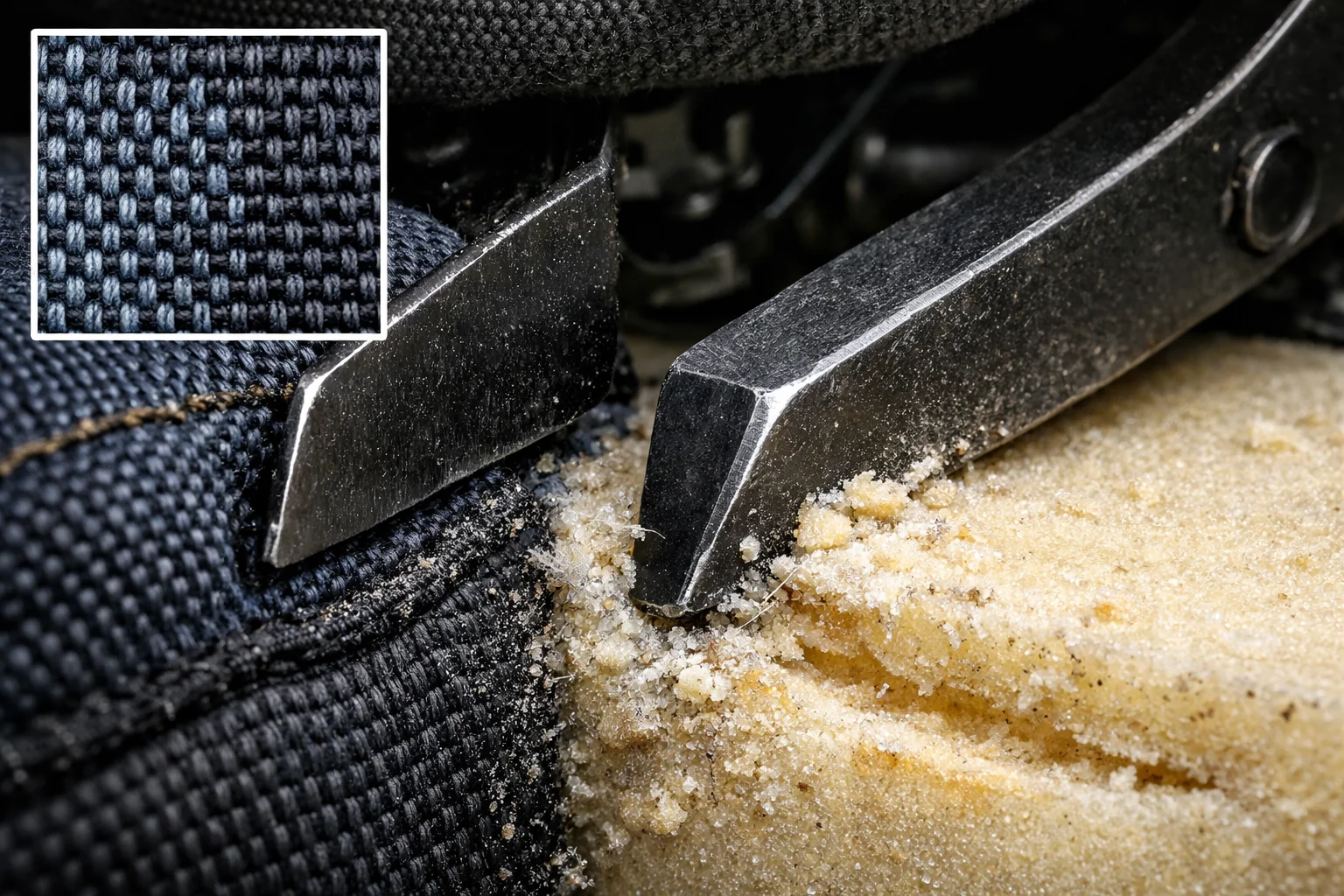
This photo is the kind of detail I look for because it explains a lot of “mystery sag” that shows up even when the top of the cushion still looks decent. Under many recliners, the steel scissor mechanism sits close enough to the foam that, over time, movement and vibration can rub and grind the underside of the cushion like sandpaper.
What I want you to do in the showroom is ask permission to look underneath, then actually crouch down and use your phone light. I am looking for a protective barrier layer between the mechanism and the foam, usually a denim like fabric, a tough mesh, or a heavy felt that is there specifically to take abrasion instead of the foam taking it.
If you see bare foam sitting right against metal, I treat it as a long term risk even if the chair feels great today. That is the setup where the cushion can start sagging from the bottom up, because the foam gets chewed up underneath, and you end up sitting into a low spot that feels like “the chair is suddenly thinner” even though you never see damage from the top.
You can also do a quick reality check with your hand. While the chair is upright, press under the front edge of the seat where you can reach, and feel whether there is a firm fabric layer before you feel foam. If all you feel is soft foam and then hard metal nearby, I assume that area is going to be punished every time the mechanism cycles.
I also pay attention to how neatly the underside is finished, not because I care about looks under a chair, but because it hints at whether anyone bothered to protect the parts that move. When I see that barrier fabric properly attached and spanning the contact zones, I take it as a small sign the builder has thought about wear, not just showroom comfort.
If you cannot see the underside at all because it is fully enclosed, I do not automatically panic, but I get more direct with my questions. I ask whether there is an abrasion barrier between the mechanism and the seat foam, because if the answer is a blank stare or a dodge, you are back to buying blind, and that usually shows up later as a sag that nobody can “refluff” away.
2. The Footrest ‘Heel’ Zone
The footrest is the part most people forget to judge until they get the chair home, and then it becomes the thing they complain about every night. A lot of recliners build the footrest like a simple shelf, basically a hard board with about an inch of foam on top, because it looks fine and it keeps costs down.
Your heels are the problem here, not because you are heavy, but because your weight funnels through two small points. When the foam is cheap or too thin, it does not just get a little softer over time, it crushes down until there is basically nothing left, and suddenly it feels like your heels are on a wooden plank even though the footrest still looks padded.
In the showroom I extend the footrest, put my heels where they naturally land, and then I stay there for a minute instead of constantly shifting. If I start to feel a hard plate through the padding, or I can tell my heels are creating two little dents right away, I assume that sensation is going to get worse at home, not better.
I also do a simple comparison press with my hands. I press down with my palm near the middle of the footrest where pressure is spread out, then I press with my thumb or knuckles right where my heel would sit. If it “bottoms out” easily under that smaller point, that is exactly what your heel is going to do night after night.
What I like to feel instead is a slightly squishy top layer that spreads the pressure before you hit the firmer support underneath. In better builds, that usually comes from a memory foam or similar topper layer on the footrest, not because memory foam is magic, but because it helps distribute that heel pressure so you are not drilling straight through one thin slab of cheap foam.
This is one place where I actually ask a very specific question, because vague answers waste your time. I ask, “Is there a memory foam topper on the footrest, or is it just polyurethane foam over the board?” If the salesperson cannot tell you, I treat it as a sign that the footrest is probably built to a price, and you should trust what your heels are already telling you.
I also watch for a different kind of warning sign, which is the footrest feeling firm but uneven. If one heel spot feels like it hits something harder sooner than the other, or the edge feels noticeably thinner than the center, I assume the padding is inconsistent and you will end up rotating your ankles and fidgeting to escape the hot spot.
If you want to stress test it without being obnoxious, bend your knees slightly and do a gentle push down with both heels together, then relax. A good footrest feels like it compresses a bit and rebounds smoothly, while a bad one feels like it collapses instantly and stays collapsed, like you just found the board.
If the chair otherwise feels perfect but the heel zone fails this test, I personally treat it as a deal breaker unless the model clearly uses a thicker, layered footrest pad. Heel discomfort is the kind of annoyance that does not show up in a quick sit, then shows up every single time you recline, and it is hard to fix later without awkward add on pads that slide around and ruin the point of a recliner in the first place.
3. The Under-Side Abrasion
This is the failure that annoys me most, because it feels like the recliner “randomly” got saggy even if you never abused it. The real culprit is underneath, every time you open, close, or scoot the chair, the steel scissor mechanism shifts and rubs where you cannot see it.
If the underside of the seat foam is not shielded, those steel edges can act like a slow saw. The foam does not have to be low quality for this to matter, it just has to be exposed, because abrasion turns the bottom of the cushion into dust little by little, and once the bottom layer is gone the whole seat starts to sit lower and softer.
In the showroom, I ask permission to look under the recliner and I actually get my head down there with my phone light. What I want to see is a deliberate barrier between the mechanism and the foam, something like a tough denim strip, heavy mesh, or a thick felt layer that is clearly there to take rubbing instead of the foam taking it.
I get suspicious when I see bare yellow or white foam near the linkage, especially if the foam looks close enough that you could imagine it touching when someone sits. Even if it is not touching right now, the chair flexes under load, and that is when the mechanism starts kissing the foam and grinding it down over years of normal use.
I also look at how that barrier is attached, because a “good material” that is stapled in one lazy spot does not help you much. If the denim or mesh is stretched across the contact area and looks securely fastened along the edges, I treat that as a sign the builder expected movement and planned for it.
There is a quick touch test that tells you a lot without disassembling anything. With the recliner upright, I reach under the front rail as far as I comfortably can and feel for fabric first. If my fingers hit a firm cloth layer and not squishy foam, I relax a bit, because that usually means there is at least some sacrificial protection in the high rub zone.
If the underside is fully enclosed and you cannot see anything, I do not automatically reject it, but I stop relying on vibes. I ask directly whether there is a denim or mesh abrasion barrier between the mechanism and the seat foam, and I wait for a real answer, not “it’s made well.” If they cannot tell you what is separating metal from foam, I assume nothing meaningful is separating metal from foam, and I decide whether I am comfortable gambling on a sag that will be almost impossible to fix neatly later.
One more thing I pay attention to is what happens when you cycle the recline a few times. If you hear a faint scrape or feel vibration through the seat as the mechanism moves, I treat that as a hint that something is already rubbing somewhere, and I go back under and look again, because foam loss from abrasion usually starts as a subtle “this seat feels thinner than it should” long before it looks damaged from above.
This heat map is what I want you to picture while you are doing that fully reclined tailbone test. In real life, you are not “sitting on the whole cushion,” you are asking one small patch of foam right at the hinge to carry most of you, and that is why a chair can feel plush yet still fail fast.
When I am in a showroom, I use this idea to stop being fooled by overall softness. I want you to judge whether the chair keeps spreading your load, or whether it funnels you into a single hot spot that feels like a deepening pocket under your tailbone.
You can check this without any tools. While you are reclined, do a slow micro scoot forward and back, just an inch or two, and notice whether you can “fall into” one obvious low point that keeps catching you. If the chair keeps guiding you back into the same hinge pocket, that is the foam telling you where it is already getting overwhelmed.
Then do the hand check that actually matches the picture. Keep your weight where you lounge, and slide your hand down beside your hip so you can press right on that hinge zone, then press the flatter seat area a few inches forward. If the hinge spot bottoms out sooner, or feels sharply firmer underneath, I assume the red zone in the map is going to turn into your permanent divot at home.
After you stand up, look at the fabric at that seam and not just the center of the cushion. If the deepest wrinkle or dish is hugging the hinge line, I read that as the chair already forming a memory in the worst possible place, the place that carries you when you recline.
If you are comparing two recliners and one feels “comfier” because you sink faster, I want you to pause and interpret that carefully. The chair that keeps you a little higher at the hinge often ends up feeling better long term, because it is managing that 70 percent load without letting you drill through the foam.
When you talk to a salesperson, this is also the moment where I get specific instead of letting them sell me adjectives. I ask what the seat hinge zone is built to handle, and whether the foam there is higher resilience or reinforced, because a vague “it’s comfortable” answer does not help you when most of your weight is concentrated in that one small area.
The ‘Crown’ Illusion
The "Crown" Illusion
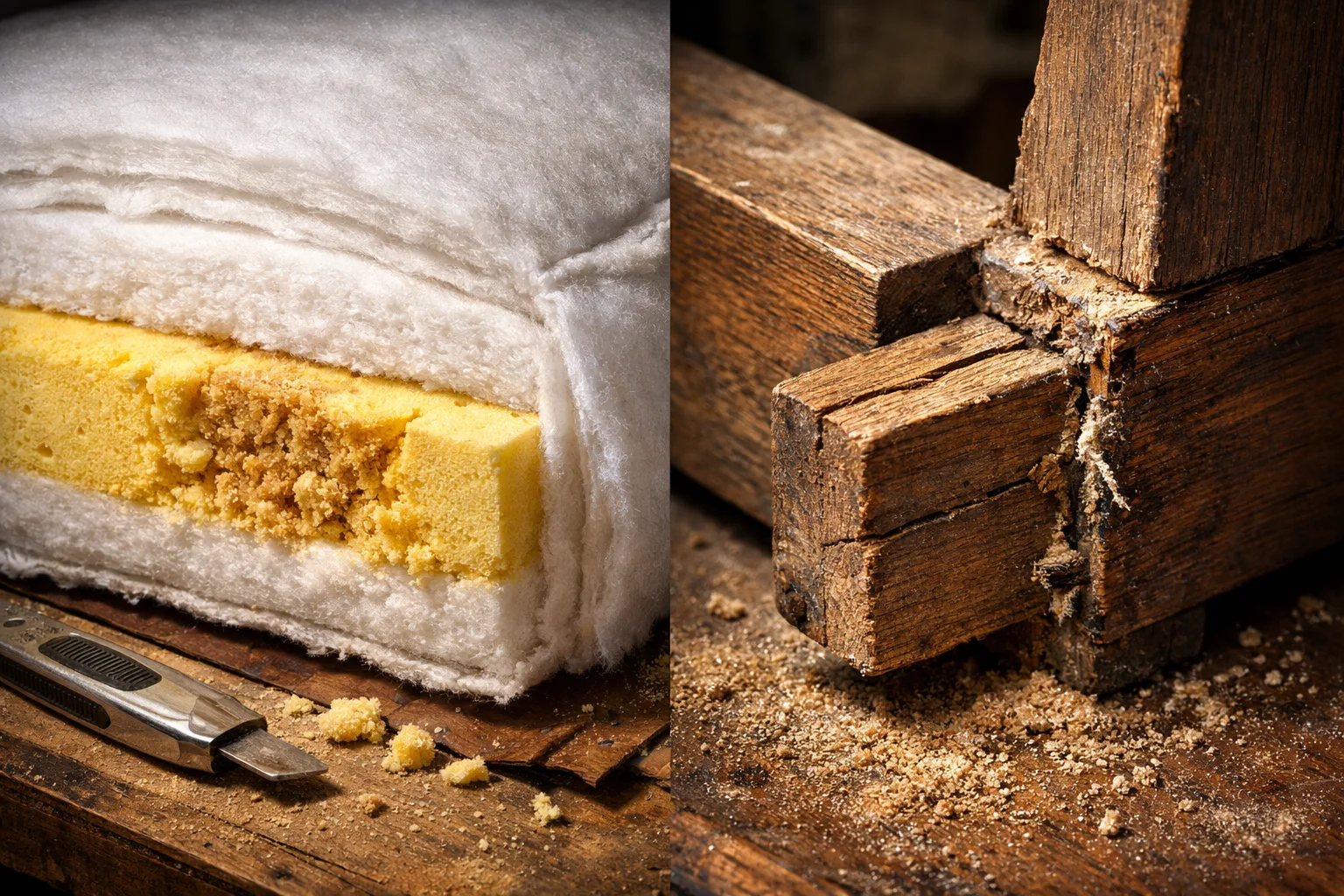
A lot of new recliners look puffy and overstuffed on the floor, and it is easy to read that as “more cushion” and therefore “more durable.” What is often creating that crowned, marshmallow look is a thick wrap of polyester fiber fill sitting on top of the real seat foam.The problem is that fiber fill is basically cosmetic loft. It can feel welcoming at first touch, but it does not have the springy structure that keeps you supported at the gravity apex. After a few months of normal sitting, that puffy crown tends to pack down, and once it does you are no longer judging the chair you tried in the showroom, you are judging the thinner foam core that was hiding underneath.
In the store, I try hard not to let surface puffiness decide anything for me. I want you to treat the “crown” as decoration and focus your questions and your hands on the foam core density, because that core is what will be holding you up when the fiber fill stops posing for the showroom lights.
Here is how I keep myself honest when a chair looks extra plush. I do a two stage press, first I pat and squeeze the top like a pillow to feel that airy fiber loft, then I press slowly with my palm until I feel the deeper layer push back.
If the first inch or two feels like fluff and then I suddenly hit a much firmer layer, I assume the crown is doing most of the showroom work. That is not automatically evil, but it means you need to like the feel of the underlying foam, because that is what you will be living on once the fluff settles.
I also do the stand up and look test specifically for the crown. When you get up, watch whether the puffy top stays kind of rumpled and needs time to “reinflate,” because that is fiber fill behavior, not foam resilience.
Then I ask one question that cuts through a lot of sales talk. I ask whether the seat cushion has a fiber fill wrap over a foam core, and if so, what the foam density is in the core.
If the answer is clear and specific, I can work with that. If the answer is vague and they keep steering me back to how soft and overstuffed it feels, I assume I am being sold the crown, not the structure.
If you want a physical check that is hard to talk your way around, use the pinch at the edge. I pinch the seat cushion at the front rail, because you can often feel whether you are mostly holding fluffy batting or whether there is a substantial slab of foam right under the cover.
I also pay attention to how quickly the chair goes from “puffy” to “bottoming out” when I do the full recline tailbone test you already read about. A chair that looks like a cloud but lets you find a hard layer under your tailbone in a couple minutes is almost always a crown illusion, because the loft is not the same thing as support.
If you like the look of that overstuffed style, I am not telling you to avoid it. I am telling you to make the core prove itself by staying supportive after you have been reclined for a while, then rebounding close to flat when you stand, because the crown will not save you once the honeymoon loft is gone.
Foam Density Survival Guide
The foam density conversation gets confusing fast, so I use it like a quick sorting tool. Density is not the same thing as firmness, it is closer to how much material is in the foam and how well it tends to survive repeated crushing, which is exactly what a recliner does at the tailbone hinge and on the footrest.For the main seat core, I personally get nervous below about 2.0 pound density because that is where I have seen that “tailbone hole” show up early, even when the chair felt great on day one. If you can confirm something closer to 2.5 pound high resilience foam in the core, I treat that as the kind of spec that is at least designed for years of concentrated load, not just a quick sit test.
For lumbar support, I do not need it to be as dense as the main seat, but I do want it to be deliberate. If you hear “about 1.8 pound” and the chair still feels like it is holding your lower back without a pillow jammed behind you, that can be fine, and I like it even more when they describe it as zoned support instead of one uniform slab that either pokes or disappears.
For the footrest, I have learned to treat it as its own budget line item. Around 1.5 pound density can be acceptable if there is enough thickness, but what makes the biggest day to day difference for me is a layered feel, meaning a more supportive base with a pressure spreading topper, often memory foam, so your heels do not drill straight through to the board.
For the arms, I keep my expectations realistic because arms are often padding over frame, not a big cushion. I still look for at least a basic 1.2 pound type foam, and I prefer when it is wrapped, because a wrap can hide edges and keep the arm from feeling like a hard rail once the outer padding relaxes.
The practical showroom move is to ask one clean question and then match it to what your body felt. I ask, “What is the seat foam density in the core, and is it HR foam,” then I stop talking and see if I get a real number. If all you get is “high density” with no spec, I assume you will never know what you are buying, and then I put extra weight on the tailbone hinge test and the rebound check because those are the only honest signals left.
If you do get a number, I do not treat it like a promise, I treat it like a plausibility check. When a salesperson claims “premium foam” but the seat is already leaving a deep dish after one long recline, I trust the dish, not the adjective, because foam that is built to survive usually does not look tired in the showroom.
Explore Technical Reference
Foldable Floor Sofa: The 3 Core Failure Points
The predictable failure points of foldable foam sofas. Understanding
Analyze Details →
Daybed Seating: The Edge Support Equation
Why the choice between a true mattress and a sofa cushion determines whether a daybed succeeds as both seating and sleeping surface.
Analyze Details →