Recliners: The Engineering of Motion
Introduction
When I started paying attention to why certain recliners turned into squeaky, saggy headaches, the pattern was simple. The ones that failed did not fail because the fabric wore out first, they failed because the moving parts got sloppy, bent, or out of sync.
I want you to walk into a showroom assuming a recliner is closer to a bicycle than a box of wood. It has joints, pivots, leverage points, and parts that rub against each other every single time you sit down, lean back, or close the footrest.
If you remember only one thing from this guide, remember that comfort on day one is easy to fake with soft foam. Durability shows up in how the mechanism feels and sounds when you operate it, and how well the frame and seat stay stable while the mechanism is under load.
When you test a recliner, I want you to stop treating it like a quick sit. I want you to treat it like a repeated motion tool and do the same motions you will do at home, slowly and a little awkwardly, because that is where the weak points reveal themselves.
You are going to hear sales language that tries to make the moving parts sound mysterious, like it is all proprietary and you should not worry about it. I do not buy that anymore, and you should not either, because you can learn a lot just by using your eyes, hands, and ears for thirty seconds.
Steel scissor linkages are the folding arms underneath that lift and support the footrest and guide the recline. What I look for is whether they feel tight and controlled, or whether they clank, wobble, or shift sideways when I apply pressure with my legs.
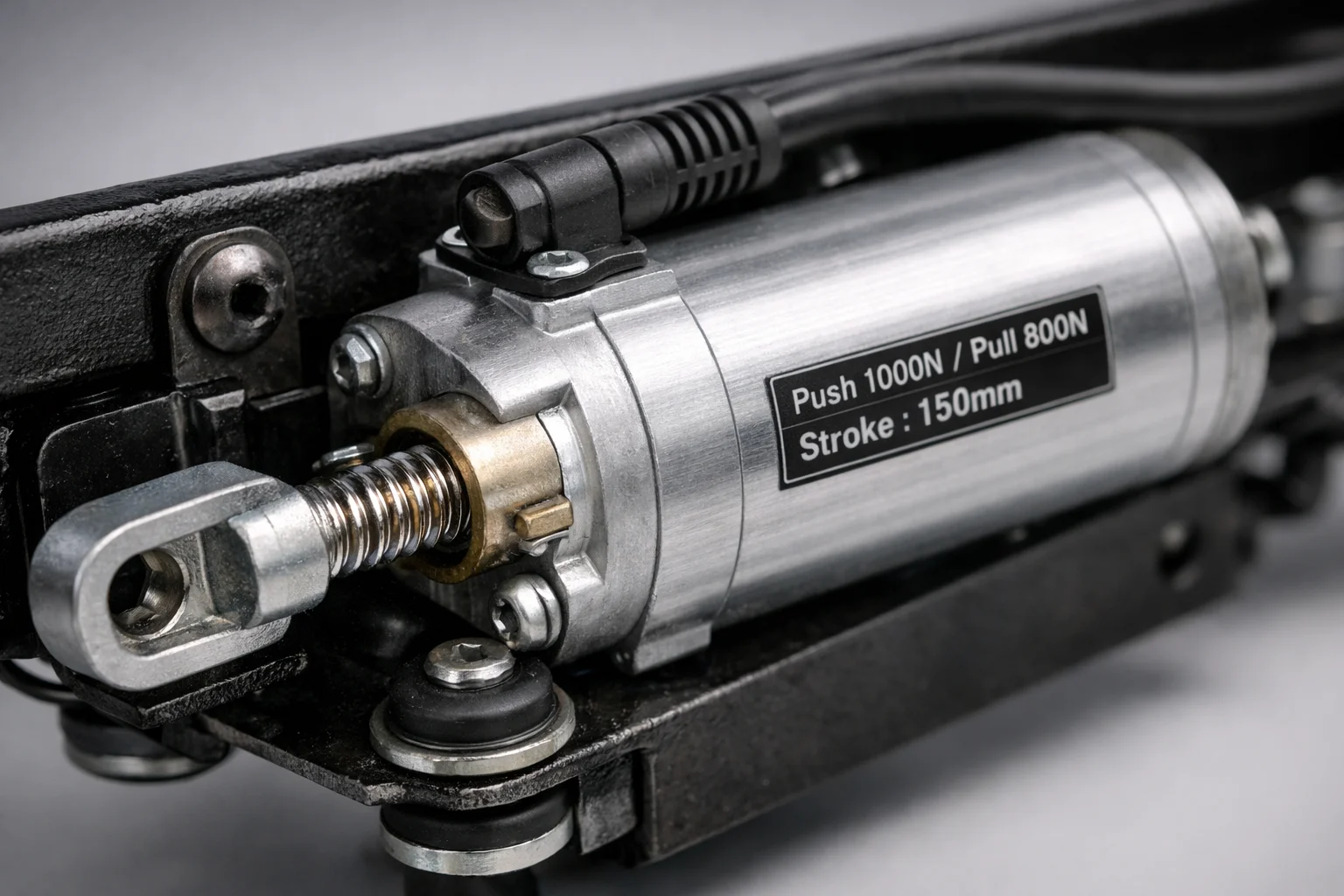
Linear actuators show up in power recliners, and they are basically the motorized pushers that drive the motion. What you can actually check is whether the motion is smooth and consistent, whether it struggles, and whether the mechanism sounds strained or chatters when it starts and stops.
Pivot bushings are the quiet, boring pieces that often decide whether the chair stays tight over time. In plain terms, these are the wear surfaces at the joints, and if they are cheap or poorly fitted you get play in the mechanism, then noise, then the feeling that the chair is twisting under you.
I am not asking you to become an engineer. I am asking you to shop like someone who knows moving furniture has failure points, and that you can spot them early if you test the chair like you mean it.
In the next sections, I will show you exactly how I test stability, alignment, noise, and closing force in a showroom, and how I read the answers when a salesperson tries to redirect the conversation to fabric and cupholders.
The "Direct-to-Wood" Failure
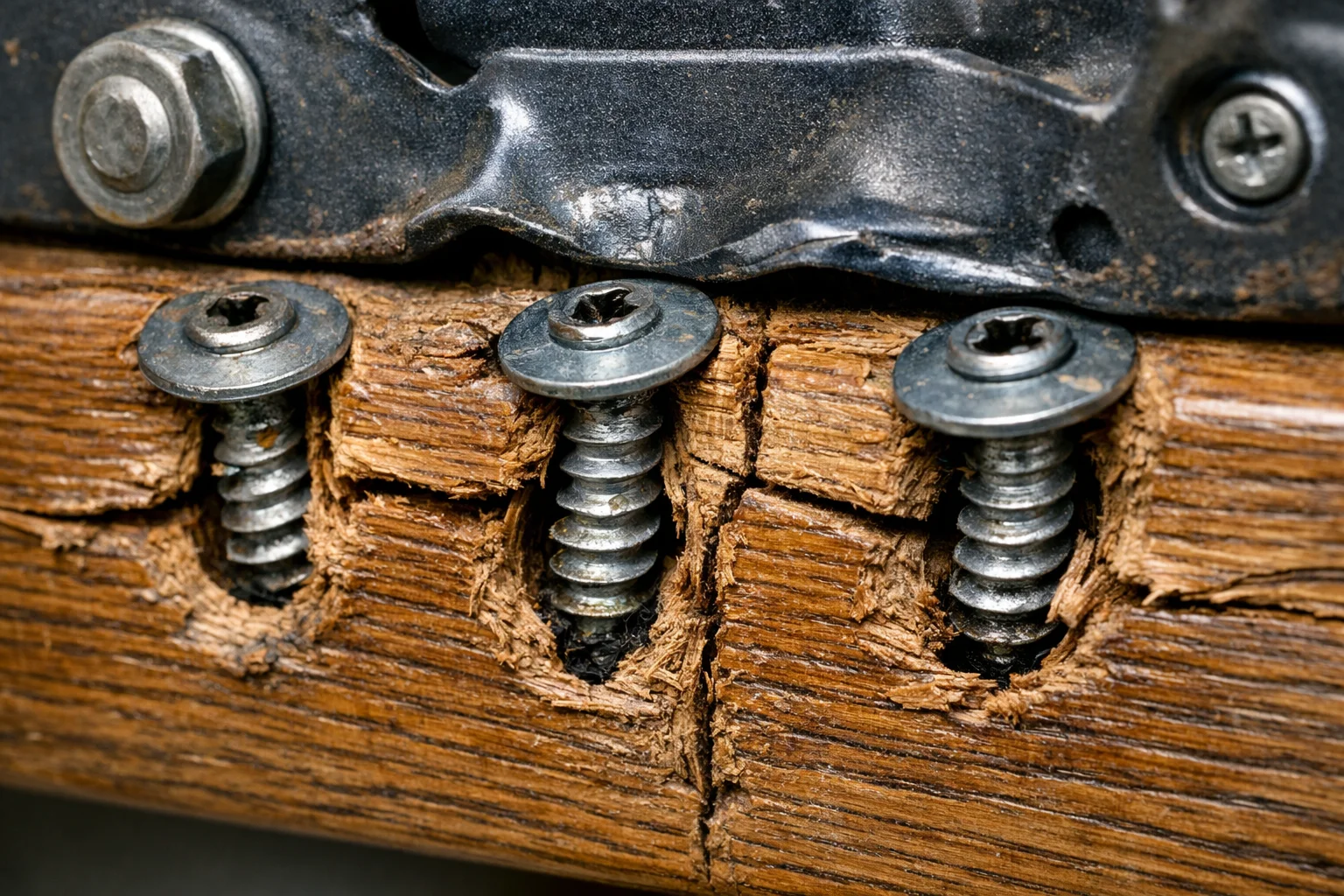
The most common structural failure I see in budget recliners is not the metal mechanism snapping. It is the mechanism slowly tearing itself out of the wood it is screwed into.Every time you recline, you are putting a big twisting load into a few mounting points. In plain terms, the chair is using those screws like little anchors while your weight and the lever action of the footrest try to pry everything sideways.
On higher end builds, there is usually a steel chassis, meaning the mechanism bolts to steel instead of relying on screws biting into soft wood. The steel base then attaches to the wood frame, so the wood is not taking the direct beating from the mechanism.
On a lot of cheaper recliners, the mechanism is simply screwed straight into soft pine rails. Over time those screw holes get chewed out, the mechanism shifts, and the whole chair starts to feel like it is slightly out of square.
In a showroom, I try to catch early signs of this by doing two things. First, I extend the footrest and then push it gently side to side with my feet, not violently, just enough to see if the mechanism tracks straight or if it wants to skew. If the footrest visibly drifts toward one arm, or I feel a loose lateral wobble, I assume the mounting is relying on wood that will loosen faster.
Second, I pay attention to alignment when closing. If the footrest starts rubbing, scraping, or kissing the upholstery on one side near the arm, that is often the story, the mechanism is no longer sitting where it should, and now it is fighting the frame every cycle.
If you can see under the recliner, look for what the mechanism is attached to. I look for a continuous metal base or at least substantial metal cross members that the mechanism bolts into, rather than a thin wood rail with a cluster of wood screws driven straight into it. If the salesperson says the frame is “solid wood,” I do not let that end the conversation, because solid softwood is still softwood when you are repeatedly levering metal against it.
When I find a recliner I like, I also do a simple load test that tends to reveal sloppy mounting. I sit down, extend the footrest, then shift my weight slightly to one side like I am reaching for something on a side table. A well supported mechanism feels planted and returns to center, a direct to wood mount that is already loosening often telegraphs a tiny twist and a little click as it settles.
If you hear a single clunk right as the footrest takes your weight, or right as it locks home, I treat that as a yellow flag. A quiet whoosh or soft mechanical settling is normal, a sharp knock that repeats every cycle often means something is moving that should be fixed in place.
Mechanism Geometry
Mechanism geometry is the boring sounding topic that decides whether a recliner will fit your room and whether it will still feel smooth after years of use. I pay attention to it because the geometry determines how far the chair has to travel, what parts are doing the work, and what gets stressed every time you recline.
The Traditional Recliner
A traditional recliner is the simple, old school setup where the back pivots around a fixed point. The catch is that to fully recline, the top of the back has to swing backward into the room behind it, and that usually means a noticeable amount of clearance.
In a showroom, I do not guess. I stand next to the chair, recline it slowly, and watch the top edge of the back as it moves. If you have a wall behind your recliner at home, you should assume this style will either hit it, or force you to keep the chair pulled out farther than you wanted.
If you are trying to simulate your real room, I like the “shoebox test.” I ask the salesperson if I can slide a small box or even my shoe behind the chair to represent a wall line, then I recline it and see what actually happens. If the chair needs a big gap to recline without scuffing, I take that seriously, because you will not enjoy living with a recliner you have to keep dragging back into place.
The other thing I watch is what the chair does to the floor when it needs that extra travel. If it wants to creep backward as you recline, that is a sign you will be nudging it into the wall over time, especially on hard floors or rugs that slide.
The “Wall-Hugger” (Zero-Wall)
A wall hugger, sometimes called zero wall, changes the motion so the seat slides forward on a track while the back drops. In plain terms, it is trying to create recline space by moving you forward instead of swinging the whole back far into the wall.
This is the geometry I look for when you want a recliner close to a wall, but I still verify the clearance in person. I put my hand behind the chair near the top of the back and recline it, slowly, because that tells me whether it really only needs a few inches or whether the shape of the upholstery still bulges back farther than the salesperson implies.
The trade off is that wall huggers usually have more moving parts doing more coordinated work. When I test one, I listen and feel for anything that suggests the track is not happy, like a gritty sensation, a hesitation, or a little lurch as it passes through mid recline.
If you can see underneath, I look for the track area and check whether it is an open invitation for debris. Coins, bobby pins, pet kibble, and little toys end up under chairs, and a track mechanism is the kind of thing that can jam or start clicking when something gets in the wrong place.
In a showroom, I mimic that real world messiness by running the recliner through multiple cycles without babying it. I open it, close it, open it again, and I do it at slightly different speeds, because a mechanism that only behaves when you operate it perfectly is not the mechanism you want in your living room.
If you are deciding between these geometries, I think about it like this. Traditional recliners are simpler in motion but demand space behind them, and wall huggers save space but ask more of the track system. Your job in the showroom is to confirm which compromise you can actually live with, then choose the chair that performs that motion with the least drama in sound, smoothness, and alignment.
Technical cutaway of a recliner scissor lift mechanism

When you look at a scissor lift mechanism as a cutaway, what jumps out is how many joints have to cooperate. That is why I stop thinking of “the mechanism” as one sturdy thing and start thinking of it as a chain of little wear points that all have to stay tight if you want the chair to feel solid years later.
Those pivot points and bushings exist to keep metal from grinding on metal, and to keep the motion quiet and guided. The catch is that once any one of those points develops play, the looseness does not stay isolated, it spreads into a chair that starts to feel like it is moving in two directions at once.
In a showroom, I do a slow motion cycle on purpose, because speed hides slop. I extend the footrest while watching the gaps between the arms and the moving footrest board, and I am looking for symmetry, meaning the left and right sides should move like they are mirrored, not like one side is lagging.
Then I do the same cycle again while lightly loading it with my legs. I rest my calves on the footrest and add a little pressure as it rises, because that is closer to how the chair works when you actually use it, and it can reveal a linkage that binds or pops only under load.
What I want to feel is one continuous arc of motion with consistent resistance. If I feel a spot where it gets easier, then suddenly harder, or I feel a small bump like it drops into a notch, I assume the links are not tracking cleanly, or something is already slightly misaligned.
Noise is a bigger deal than people admit, because it is often the first symptom. I do not panic about a faint motor hum on a power chair or a soft mechanical swish, but I take clicking, ticking, and dry squeaks seriously, especially if the sound repeats at the same point in the travel every time.
A repeated click at a particular angle is usually a joint shifting from one position to another because it cannot stay snug. That can be a worn bushing fit, a loose fastener, or two parts that are barely clearing each other, and none of those tends to get better with age.
I also do a side load check that tells me a lot about the scissor geometry. With the footrest out, I put my feet near the outer corners and apply gentle alternating pressure left, then right, like I am testing if it wants to rack out of square, and I watch the footrest edge relative to the arms to see if it drifts.
You are not trying to break it, you are trying to see how much lateral stiffness the mechanism has built in. A good one feels like it is riding on rails, a marginal one feels like a folding camp chair, where you can sense the joints taking turns bearing the load.
If you can get your head low enough to see underneath, I look for two practical things. I want to see that the left and right scissor stacks look like the same thickness and build quality, and I want to see that the pivot areas are not already shiny and chewed up, which can be a clue it has been rubbing or flexing even as a floor sample.
Power recliners add one more real world test here, which is stopping mid travel. I run it out halfway, stop it, then reverse direction, because a mechanism with sloppy pivots often clunks on reversal as the play gets taken up, and that is the exact sensation that turns into that loose, worn out feeling later.
If the salesperson tells you it has “nylon bushings for smooth operation,” I treat that as a starting point, not a conclusion. What matters to you is whether the chair moves quietly and evenly now, and whether it stays aligned when you add the kinds of crooked, everyday loads people actually put on recliners, like leaning to grab a drink or sitting slightly off center.
The final thing I do is a closing check, because closing is where a lot of scissor mechanisms reveal themselves. I bring the footrest in slowly and listen for any scrape near the upholstery, and I pay attention to whether it seats home with a soft, controlled finish, or whether it snaps shut with a knock, which can mean the linkage is hitting its stops hard instead of settling into them cleanly.
Manual vs. Power Actuators
Manual vs. Power Actuators
A manual, spring assisted recliner uses a high tension spring to pop the footrest up when you pull the lever. In a showroom I check two things right away, how violently it pops, and how controlled it feels on the way back down. If it snaps up like a mousetrap, that can feel fun on day one, but it also hints that the chair is relying on a lot of stored force, and that same force is what you will fight every time you close it.The most honest test is closing it slowly with your legs, without a running start. If you have knee, hip, or low back issues, or if anyone in your home is smaller or older, I want you to pay attention to whether they can close it cleanly without shifting their whole body forward or bracing on the arms. If closing takes a hard shove, you will either leave it open more often than you think, or you will start closing it in a way that twists the chair, and that is when mechanisms get out of square over time.
A power recliner uses an electric linear actuator, basically a motor pushing through a gear drive, to move the footrest and recline. The practical upside is that you can stop anywhere you want in the travel, so you can set a comfortable angle instead of living with just a couple of notches. The practical downside is speed, most take long enough to fully recline that I always test whether I can tolerate the wait, and whether the motion stays smooth the whole time.
When I test power, I do not just run it all the way out and call it good. I stop it mid recline, reverse it, stop again, and reverse again, because that is where I catch clunks, hesitation, or a little jump as slack gets taken up. I also listen at the start and end of travel, because a strained sound or chattering right as it loads up can be a sign the actuator is working harder than it should, or the linkage is binding.
If you are torn between manual and power, I would make the decision based on who has to operate it and how you actually lounge. Manual can be fast and simple, but only if closing force is comfortable for you every single time. Power can be easier on your body and more adjustable, but only if you are happy with slower movement and you are comfortable living with a motor, a handset, and one more thing that can fail.
Technical Summary: Motion Specifications
I use specs like these as a truth serum, not as a way to chase the fanciest words. If you know what they mean in plain terms, you can ask one or two focused questions and then confirm the answer with what you feel when you run the chair.
When I see pivots described as steel rivets with nylon washers, I read that as a joint that is trying to stay quiet and tight while it cycles. Nylon at the pivot is not magic, but it is a real attempt to put a sacrificial, low friction layer between parts. In the showroom, you can validate that idea by listening for dry squeaks and by feeling for a tiny click when you reverse direction mid travel, because metal to metal pins tend to telegraph that kind of noise and looseness sooner.
Steel gauge is one of those specs that is easy to turn into marketing, but I still care because thin steel bends and eggs out at holes faster when it is repeatedly loaded. If the tag says 8 to 10 gauge, I expect a mechanism that resists twisting when you push the footrest side to side. If it is more like 12 to 14 gauge, I do not automatically reject it, but I become stricter about the lateral wobble test and the mid recline reversal test, because the thinner stuff has less margin when you sit off center or close it a little crooked.
Bushings are where I stop letting anyone hand wave, because they decide whether a chair stays tight or turns into a rattle. If the mechanism has oil impregnated bronze, Delrin, or even visibly distinct plastic sleeves at pivots, that tells me the maker planned for wear and tried to control it. If there are no bushings and it is steel on steel, I assume the chair will either start squeaking, or it will develop play, or both, and I try to catch early hints by running it slowly and pausing at the same angle a few times to see if a tick shows up at the joint.
On power recliners, the motor spec is one of the few places where numbers actually map to a real user experience. A 24V DC actuator generally has more torque headroom and tends to run cooler for the same work, which usually means less strain when you are actually in the chair and not just cycling it empty. A 12V actuator can be fine on a lightly loaded mechanism, but in the showroom I pay extra attention to whether it sounds like it is laboring at the start of motion, and whether it slows down when my legs are resting on the footrest, because that is the moment that exposes a system that is working near its limit.
Mounting is the spec that ties everything together, and it is the one I trust the most when it is done right. If the mechanism is bolted to a steel chassis, I expect the chair to feel more planted when I shift my weight and when I close it with one leg slightly stronger than the other. If it is screwed to plywood, I assume those screws are going to be asked to do too much over time, so I do that gentle twist test with the footrest extended, then I watch for rub marks and misalignment as it closes, because those are the early tells of a mechanism that is slowly walking out of position.
If you want a simple way to use this table while you are standing in a showroom, I would keep it conversational and direct. I ask, “Are the pivots bushed, or is it metal on metal,” and then I ask, “Does the mechanism bolt to steel, or is it screwed into wood or plywood.” If they cannot answer, I treat that like a clue, then I rely on the tests you just did, because a good mechanism usually feels good even before anyone explains it.
The honest takeaway is that professional style specs usually buy you quieter motion, less wobble, and a longer stretch of time before the chair starts feeling loose. Budget specs do not guarantee failure, but they do mean you should be more demanding about noise, alignment, and twisting under load, because those are the ways the cheaper choices show up in your living room.