Modular for Renters: The Portability Premium
Introduction
If you rent, I treat a traditional 84 inch sofa like a bet you might lose. You are betting your next place will have an elevator that fits it, a hallway that turns the right way, and a doorway that is not oddly narrow.
I have watched people get trapped by a perfectly nice sofa that simply would not make the corner, then they either pay movers to hoist it, pay someone to disassemble it, or sell it cheap just to make the problem go away. Even if it fits, the room can flip on you, windows and radiators land in the wrong spots, and suddenly the “right” sofa forces your whole layout.
This is why I like modular systems in theory. They turn one unmovable object into a set of manageable boxes that can be carried, rotated, and reassembled when your life changes.
That said, modular is not automatically safer. In a showroom, I want you to think about two things at the same time, whether it will move easily later, and whether it will stay tight and comfortable after a few years of sitting.
Start by imagining the worst path, not the best one. Ask for the dimensions of the largest single module, not the overall sofa, then picture it going through your building’s tightest spot, usually the stair landing or the turn into your unit.
Then I do a simple “grab and wiggle” check at the seams. Put one hand on each side of a connection between modules and try to twist, not violently, just enough to feel play. If it clunks, shifts, or squeaks in the showroom, it rarely gets better at home.
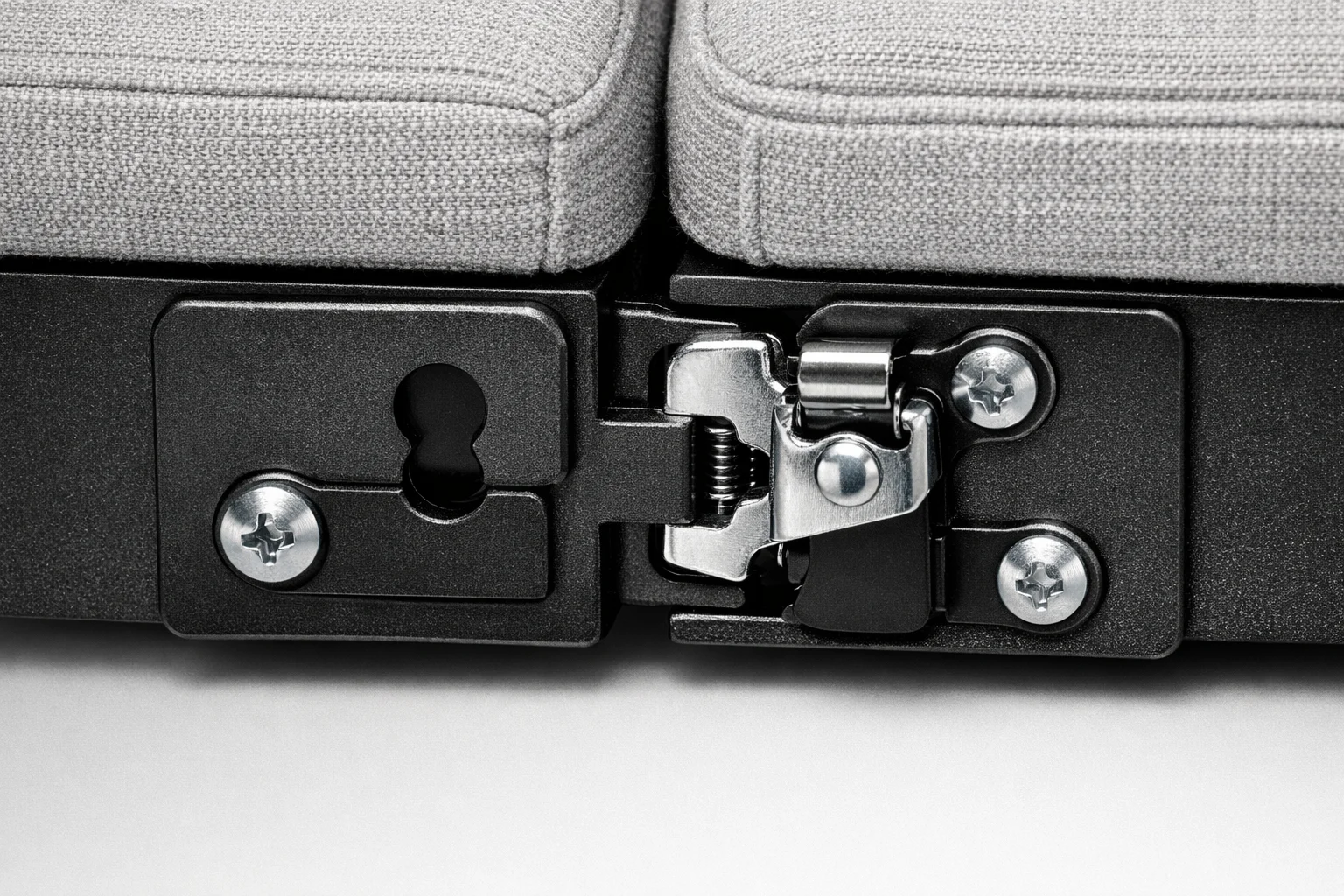
Next I look for how the pieces lock together, because that is the real make or break point. I prefer connectors that feel like hardware, something that pulls sections together and resists sideways drift, rather than light hooks that mainly keep the pieces from separating.
I also pay attention to whether the cushions hide the joints. When a modular is comfortable only if the cushions land perfectly, those cushions will eventually drift, and you end up sitting on a crack.
If you take one practical thing from this intro, it is this. I want you to shop modular like you are buying both a sofa and a piece of moving equipment, because you are, and the little details at the joins and the size of the biggest box are what decide whether it stays a convenience or becomes a headache.
Dimensional Agnosticism
Most moving disasters happen at the pivot point, that one corner on a staircase or hallway where a long sofa cannot rotate enough to make the turn. In a showroom I mentally stop thinking in “overall length” and start thinking in “largest single piece,” because that is the thing you will actually be wrestling through the building.When you are looking at a modular, ask them to tell you the size of one armless seat module, not the pretty staged configuration on the floor. A lot of systems land around a roughly cube shaped seat, and that shape is the reason modular can be a lifesaver, it is easier to tip, rotate, and sneak through weird old doors than a single long frame.
I also want you to check something people forget, the height and depth of the module when it is held upright on its end. Movers do this all the time to cheat a tight turn, and it only works if the piece does not become too tall to clear a low ceiling at the landing.
If you are renting or you move even occasionally, I treat “fits through a normal doorway” as a buying requirement, not a nice bonus. I would rather have a sofa made of smaller units that I can always get in and out, than a slightly prettier one that becomes a hostage the moment you meet a narrow stair and a sharp turn.
There is also a real DIY win here if the pieces stay manageable. I have moved modular sections with one other person without hiring movers, and that changes the economics, because you are no longer paying for a crew just to deal with one awkward, oversized object.
In the showroom, be blunt and ask what the heaviest single module weighs and whether two average adults can carry it without special straps. Then look underneath and make sure there are real handholds or at least a frame edge you can grip, because smooth fabric wrapped around foam is miserable to carry and easy to drop.
If you have a car, think about your own loading reality. A modular that breaks down into a few boxy pieces can fit in an SUV with the seats down, and even if you need two trips, you are still in control of the move instead of negotiating with a moving company about “oversize item” fees and staircase headaches.
The point of dimensional agnosticism is simple, you are buying flexibility. I want you to choose a sofa that does not care what your next apartment looks like, because the less the sofa dictates your life, the less likely you are to get forced into a rushed sale or an expensive rescue when the pivot point wins.
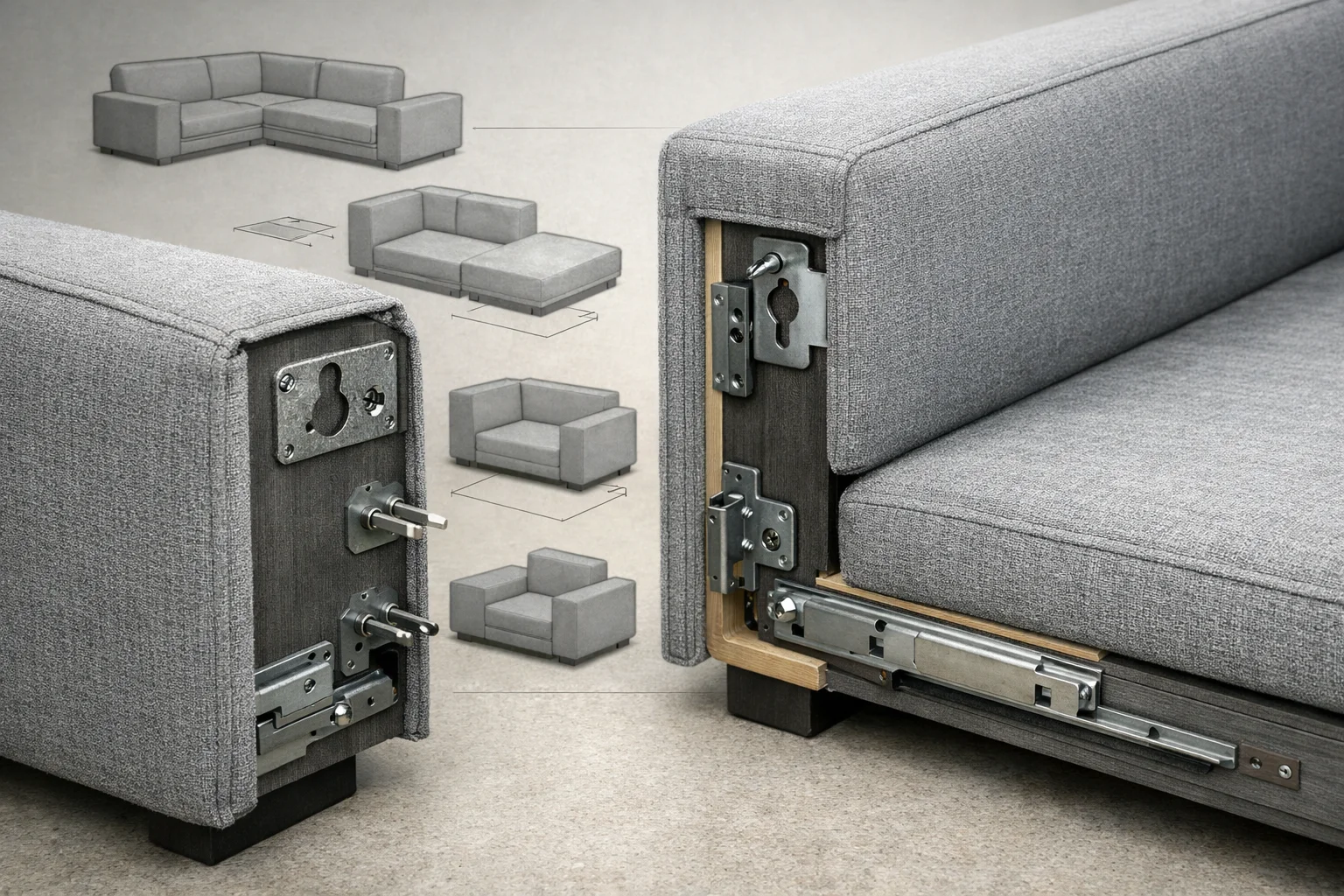
When you look at a modular in person, I want you to get your eyes and hands on the actual connection system, because that is where the “moves easily” promise either becomes real or turns into daily irritation.
In that photo, the idea is keyed hardware plus alignment pins, meaning the pieces have to meet in the right place before they fully seat. In a showroom, I try to lift one side of a joined section just a little, then set it back down and see if it naturally drops into the same position without me hunting for the latch.
I also watch for whether the connector pulls the pieces together, not just keeps them from drifting apart. If you can push the modules sideways with your knee and the seam opens up, you will be fixing that seam constantly at home, especially on rugs.
I want you to check what happens when you sit right on the joint. Put your weight near the inside corner where two modules meet and see if you feel a hard edge, a dip, or a shift, because that spot gets punished in real life when people perch, slide, and flop down.
Then look for interchangeability, like arms that can swap sides or mounts that let you reconfigure without buying special left and right parts. I have seen renters get stuck with a “perfect” sectional that only works in one layout, and the next apartment forces them to park an awkward chaise in front of a door.
Ask the salesperson to show you, physically, how the arm comes off and goes back on, and pay attention to whether it feels like furniture hardware or like a wobbly camping cot. If they will not demonstrate it, or they need to disappear to find a tool, I treat that as a sign the system is not meant to be reconfigured often.
Finally, take a quick look under the skirt if you can, or at least crouch and peek at the join. I trust connections more when I can see real metal, a clear engagement point, and a design that does not rely on the fabric or the cushion to hide misalignment.
The Reconfiguration Pivot
The biggest advantage for renters is not only that a modular gets through the door. It is that you can change what the sofa is after you move, when the new room refuses to cooperate.
I picture the classic flip. In one apartment, a left facing L shape tucks neatly into the corner and it feels like you planned the whole place around it.
Then you move and the new living room has a fireplace, a radiator, or a doorway exactly where that return piece wants to live. This is where a good modular earns its keep, because you can unclip the corner and stop treating the sectional like a single identity.
In the showroom, I want you to ask them to show a configuration swap, not just talk about it. I ask to see the same pieces built as an L, then separated into a straight sofa, and if the system allows it, a standalone chair or ottoman with no weird gaps.
Pay attention to what changes when you do this. Some systems look great as a sectional but get visually and physically awkward as soon as you split them, because the “inside” edges were never meant to be exposed.
The practical check is simple. Look at the side that becomes “finished” after the swap, then run your hand along it and check whether it has a real arm, a real side panel, or just a thin upholstered flap that was supposed to hide against another module.
If you cannot make a clean straight three seater without buying an extra special end piece, I treat that as a warning sign. You are not really buying flexibility, you are buying a puzzle that only works in the one staged layout you saw on the floor.
This is also where interchangeable arms matter more than people realize. If the system uses true left and right arms that cannot swap, your options shrink fast, and you can get forced into buying more parts just to make the sofa “fit” a new room.
I like to own, or at least confirm I can later buy, one extra set of arms that fit the same mounts. The reason is not style, it is survival, because with spare arms you can turn one sectional into two legitimate pieces when the next apartment is too tight for an L shape.
In person, I check whether adding or removing an arm is something you would actually do twice a year without dread. If it requires a special tool, tiny screws you can lose, or a sequence that only one employee seems to understand, I assume you will stop reconfiguring and start living with a compromised layout.
I also ask a blunt question that salespeople sometimes dodge. I ask whether the arms are truly interchangeable across the line, or whether they change the mount pattern every time the company updates the model, because renters are the ones who need parts availability a couple years later, not just on delivery day.
One more thing I watch for is the “orphan module” problem. If you split the sectional, does the leftover corner or chaise become useful, like a chair or a lounge, or does it become a weird piece you cannot place because it has no proper arm and it slides around.
If you do nothing else, do this mental walkthrough before you buy. Imagine Apartment A where the sectional is perfect, then force yourself to imagine Apartment B where something blocks the corner and you must convert it into a straight sofa plus a separate seat, and you must be able to do that with the parts you own. If the answer is “only if I buy two more pieces,” I treat the flexibility claim as marketing, not a plan.
The Disassembly Wear-Factor
If you have ever owned “knock down” furniture that uses wood screws straight into a wooden frame, you already know the dirty secret. It is fine the first time, it is okay the second time, and then one day the screw just keeps turning because the hole has chewed itself wider.
A lot of modular seating quietly has the same problem, especially if the arms or backs are meant to come off for moves. If the salesperson says it disassembles, I immediately ask what is actually taking the load, and whether anything is biting into wood each time I reassemble it.
In the showroom, I want you to push past vague phrases like “KD construction” or “knock down design” and get a plain answer. Ask whether the system relies on wood screws going into the frame, or whether it uses metal hardware that connects metal to metal.
When it is metal on metal, like steel connector plates, ratchet clips, or other interlocking brackets, the connection can handle repeated assembly without slowly degrading the way a screw hole in wood does. You still want to feel it with your hands, but at least you are not betting the life of the sofa on a piece of wood staying tight after a few moves.
My favorite quick check is to ask them to show you the connector itself, not a brochure picture. I crouch down, look under the joint, and try to see actual steel plates or a clip mechanism that engages in a defined way, because that usually means the alignment is controlled by the hardware, not by you muscling the pieces into place.
Then I do a repeatability test. I ask them to separate and reconnect two modules, even just a few inches apart, and I watch whether it snaps back to the same tight seam without fiddling. If it takes hunting, slamming, or lifting and scooting over and over, that is the kind of “easy modular” that becomes a chore on moving day and a squeak factory afterward.
If the design does use screws into wood, I do not automatically reject it, but I treat it as a one to two move sofa, not a lifetime renter sofa. In that case, I would rather buy something I plan to keep in one configuration and move carefully, than something marketed as endlessly reconfigurable that is really a limited cycle fastener.
There is also a tradeoff that surprised me the first time I took a modular apart. The good hardware tends to add weight, because those steel plates and reinforced corners have to live somewhere, usually on multiple sides of every seat box.
So when a modular looks light and airy on the showroom floor, I do not assume it will be light in your hands. I ask what one armless seat weighs, and I specifically ask if the connectors are steel and how many sides are reinforced, because a heavily plated module can be awkwardly dense.
You can sanity check this without a scale. Put your fingertips under the front rail and try to tip the module up just an inch, like you are about to slide a rug under it. If it feels unexpectedly dead and heavy for its size, believe that feeling, because stair landings and narrow halls punish dense, hard to grip pieces.
The practical buying move here is to match the connector style to your reality. If you move often, I would prioritize a modular that locks with metal on metal hardware and feels repeatable to reassemble, even if it is a bit heavier. If you move rarely and you just want the occasional reconfiguration, you can accept a simpler system, but only if it stays tight in the wiggle test and the store can demonstrate that it goes together cleanly without stripping anything.
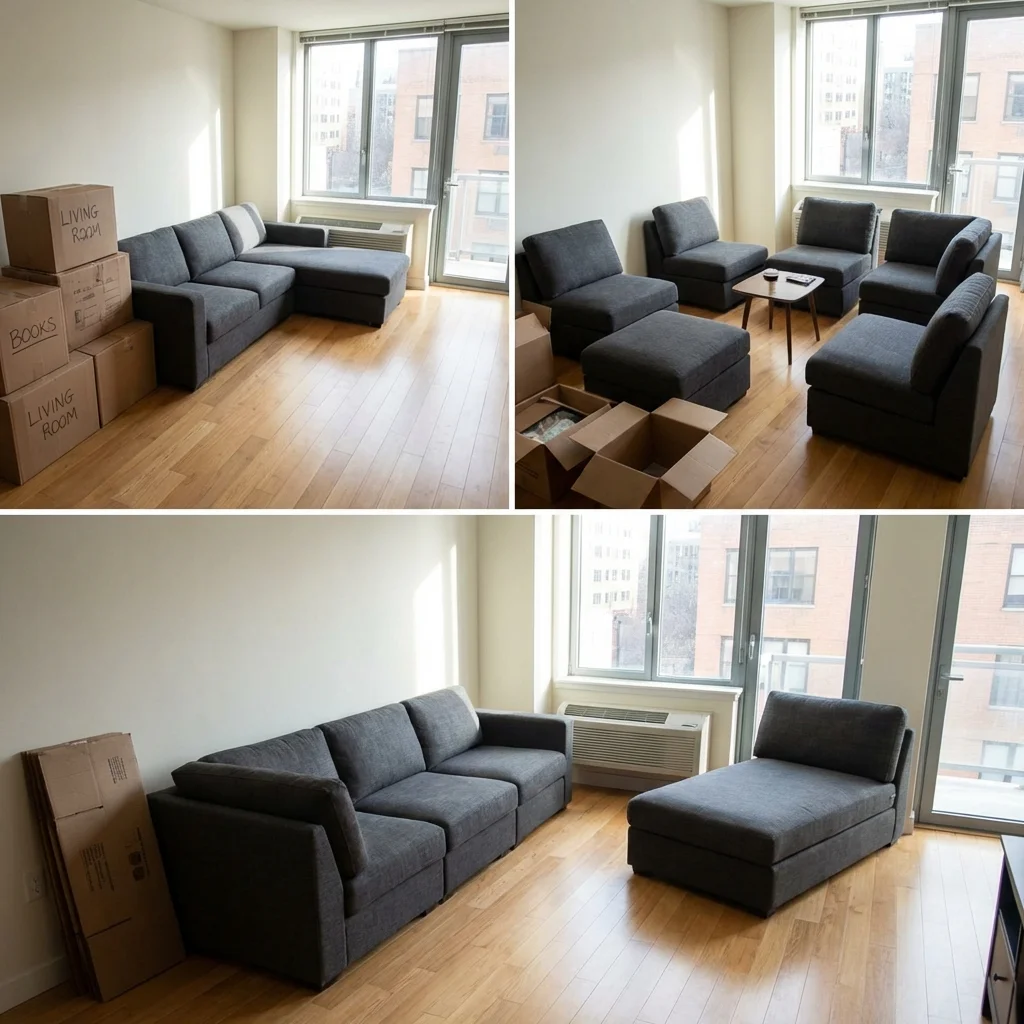
That picture is the moment I design my whole purchase around, the narrow doorway or stair turn where a long, rigid frame loses. I want you to treat this as a physical test you can run in your head while you are still standing in the showroom, because it is way cheaper than learning it on move day.
I start by asking them to point to the exact piece you would actually be carrying, usually an armless seat or a corner block, not the fully built sofa. Then I walk around it and imagine it rotated upright, because that is how movers cheat tight corners, and you need to know if that “upright footprint” is going to smack the ceiling at a landing or clip a low light fixture in an older building.
If you are serious about not getting trapped, I also want you to check whether the module has anything you can truly grab. I put my hands underneath and look for a hard frame edge, a recessed handhold, or at least a base that is not slippery fabric all the way down, because smooth upholstery plus a heavy box is how people lose control and damage walls, door trim, and their backs.
When you are looking at modular for renter flexibility, there is one more reality check I do that does not feel obvious until you have moved one. I ask what parts are attached to the module that can snag, like loose feet, delicate corner piping, or a dangling connector plate, because the tight doorway problem is not only size, it is also the stuff that catches and tears when you are pivoting under pressure.
If the salesperson is game, I ask them to show me one module carried a short distance, even just lifted and turned in place. I am not trying to be dramatic, I am trying to see if the module behaves like a solid box you can control, or like a squishy, awkward bundle that fights you the second you tilt it.
The "Legacy" Link Risk
When you buy modular with the intent to “add more later,” I want you to notice what you are really doing. You are not just buying today’s sofa, you are betting that the exact system will still exist when you need that extra corner, matching cover, or replacement cushion.The risk is simple and it bites harder than people expect. If the company goes under, gets bought and “refreshes” the line, or quietly discontinues the specific modular series, your “expandable” sofa becomes a dead end. You can still sit on it, but the whole point of modular, growing it and keeping it consistent, is gone.
In the showroom, I ask one very direct question and I listen for a confident, specific answer: how long has this exact modular line been sold under the same name, with the same connectors and compatible covers. If they say “the brand has been around forever” but cannot say how long this particular system has stayed compatible, I treat that as a dodge.
I also ask them to show me, on paper, that I can order a single seat module or a single arm later, not just a whole new configuration. If the only way to “add on” is to buy a pre bundled set, or they tell you parts are “seasonal,” you should assume you will not be able to surgically expand or repair the sofa when you actually need to.
My practical filter is to lean toward systems that have a long, boring track record of selling the same basic modules year after year. For example, Lovesac has kept Sactionals as a continuing modular platform for a long time, and IKEA tends to run modular series long enough that you can often find compatible parts for years, which is the kind of institutional inertia I want on my side when my plan depends on future availability.
Even with a long running line, I still want you to protect yourself. Before you buy, take photos of the connector hardware underneath, the model name, and any SKU on the tag, because if you ever need to match a piece later, those details matter more than the fabric name the salesperson remembers.
If you are truly buying modular because you want to expand later, I would rather see you buy from a line that is already mature than a brand new “launch” that looks trendy this year. New lines change fast, and compatibility breaks quietly, and the person stuck with the mismatch will be you.
Renter's Modular Checklist
Before I get hypnotized by fabric and “configurations,” I do a boring logistics check, because renters lose money on the parts that do not fit through real life openings. I measure my car’s hatch opening, not the cargo area, and I compare it to the biggest single box they will ship or hand me, especially if it ships knocked down and arrives as big upholstered cubes. In the showroom, I ask them to tell me the packaged size of the largest module, not just the assembled size, because a seat that fits your doorway can still fail the “will it go in my car or rideshare without a panic” test.
Then I get serious about covers, because moves are filthy and modular invites more handling. I only treat it as renter friendly if the covers are truly, completely removable, meaning you can strip the whole “skin” off each seat, back, and arm without a stapled on panel or a permanent deck layer you can never clean. I ask them to show me a zipper and start it, because “removable” sometimes means only the cushion cases come off, and the parts that get scuffed during a move are usually the sides and base, not the seat cushion you can flip.
If you care about being able to wash after a move, do not accept hand waving about “spot clean.” I look for plain language on the tag or care sheet that you can machine wash the covers, and I ask what happens if you shrink one by accident, because some brands will sell replacements and some will not, and that matters when you are renting and one stairwell scrape turns into a permanent badge.
Finally, I check the leg height like I am checking ground clearance on a car, because it decides how much control you have on rental floors. I aim for at least about two inches under the base so you can get furniture sliders under there and reposition a module by yourself without dragging fabric on hardwood or gouging vinyl plank. In the showroom I crouch and look under the front rail, because some sofas look like they have legs but actually have a low apron that blocks sliders and turns every adjustment into a floor scratching shove.
If the legs are removable, I ask whether the sofa is meant to be moved without them, because some designs become unstable or start chewing up the underside fabric when you take the legs off. I would rather have a slightly taller, more basic base that takes sliders cleanly than a low modern look that forces you to lift and twist every time you want to nudge the layout.
Explore Technical Reference
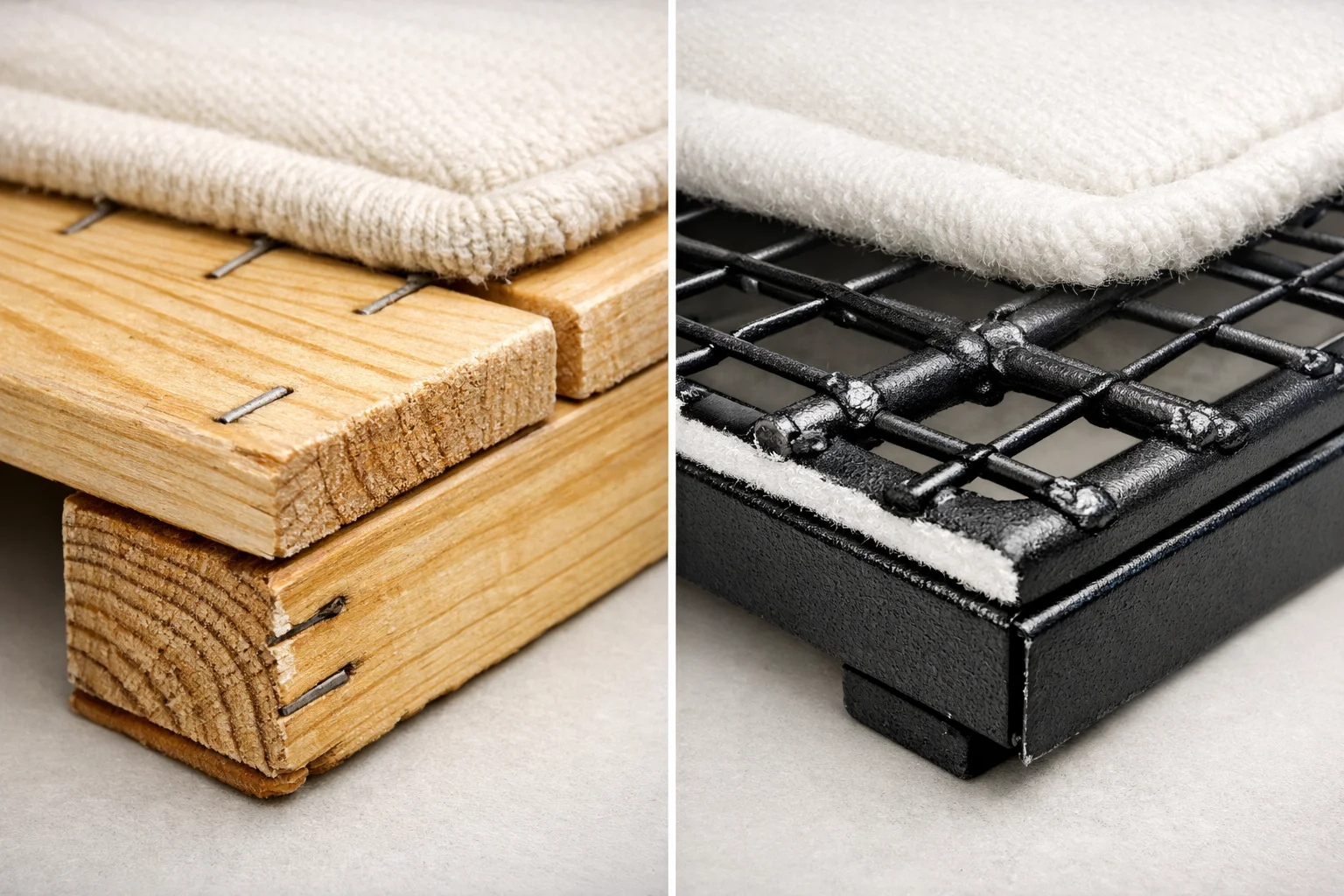
Futon or Sofa Bed: The Conversion Conflict
Comparing the two main approaches to dual-purpose seating and sleeping furniture. Why the choice depends on priorities rather than either being universally better.
Analyze Details →
Foldable Durability: The 1.8 lb Threshold
The honest truth about how long foldable sofas last under daily versus
Analyze Details →