Lightweight vs. Heavy: The Moving Day Trade-off
Introduction
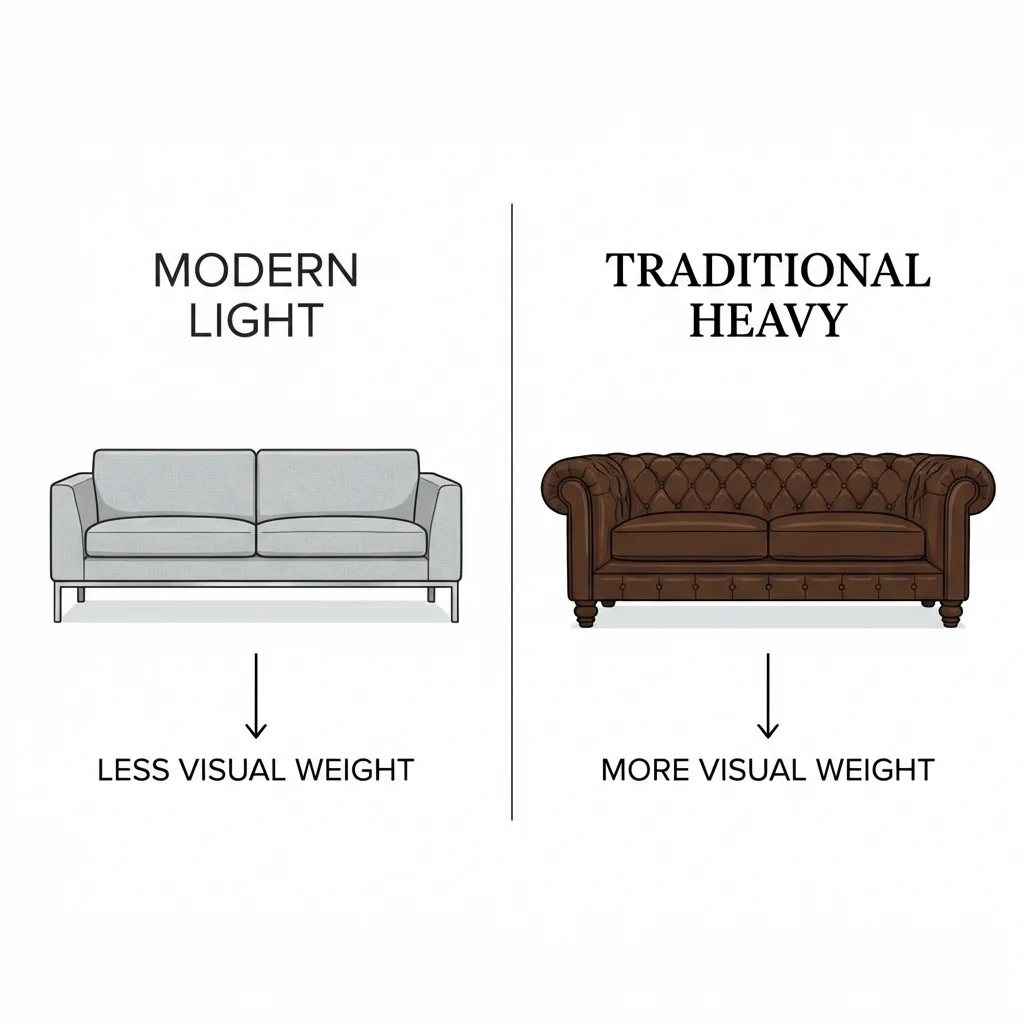
When I walk into a showroom now, the first thing I notice is how much a sofa weighs, because weight is the easiest clue to what you cannot see. Fabric and styling are loud, but the frame, the springs, and the amount of actual wood and steel are what decide whether a sofa stays solid after a few years or starts creaking and sagging.
You do not need a scale to use this. I ask the salesperson if they know the shipping weight, and if they do not, I do a simple test by lifting one front corner a few inches off the floor. If it comes up too easily, I treat that as a warning sign and I get more strict about checking the frame and the support system, because light sofas can be fine, but only when the engineering is genuinely good.
A heavy sofa, roughly in the 120 pound and up range, usually gets its stability the old fashioned way, by using more material. That often means thicker frame parts, more substantial joinery, and a support system that relies less on thin metal parts staying perfectly aligned over time.
A lightweight sofa, roughly under 70 pounds, is usually built to be moved easily and shipped cheaply, so it has to earn durability through smart design rather than mass. Sometimes that works, especially when the maker uses strong panel construction and good hardware, but I have also seen lightweight sofas that feel great in the first five minutes and then loosen up fast once real life starts.
The part most people miss is that neither approach is automatically right or wrong. What matters is your Tenure Profile, meaning how long you expect to keep this sofa in one place, how hard you will be on it, and how realistic it is that you will need to get it through tight doors, stairs, and future moves.
If you are the kind of person who moves often, lives in walk ups, or just hates the idea of a sofa that takes four people to reposition for cleaning, a lighter sofa can be the practical choice. In that case, I would rather you buy a light sofa that is honestly built for repeated moving, than a heavy sofa that you end up damaging every time you drag it through a doorway.
If you are settled for a while, you have kids or pets, or you know you are sensitive to wobble and squeaks, I lean you toward heavier and simpler construction. In my experience, mass covers up fewer sins, and the sofa has an easier job staying square as the cushions compress and the joints get stressed year after year.
In the next sections, I am going to help you figure out your own Tenure Profile quickly, and then show you what to physically check in a showroom so you are not guessing based on looks or a salesperson’s script.
The Physics of Inertia
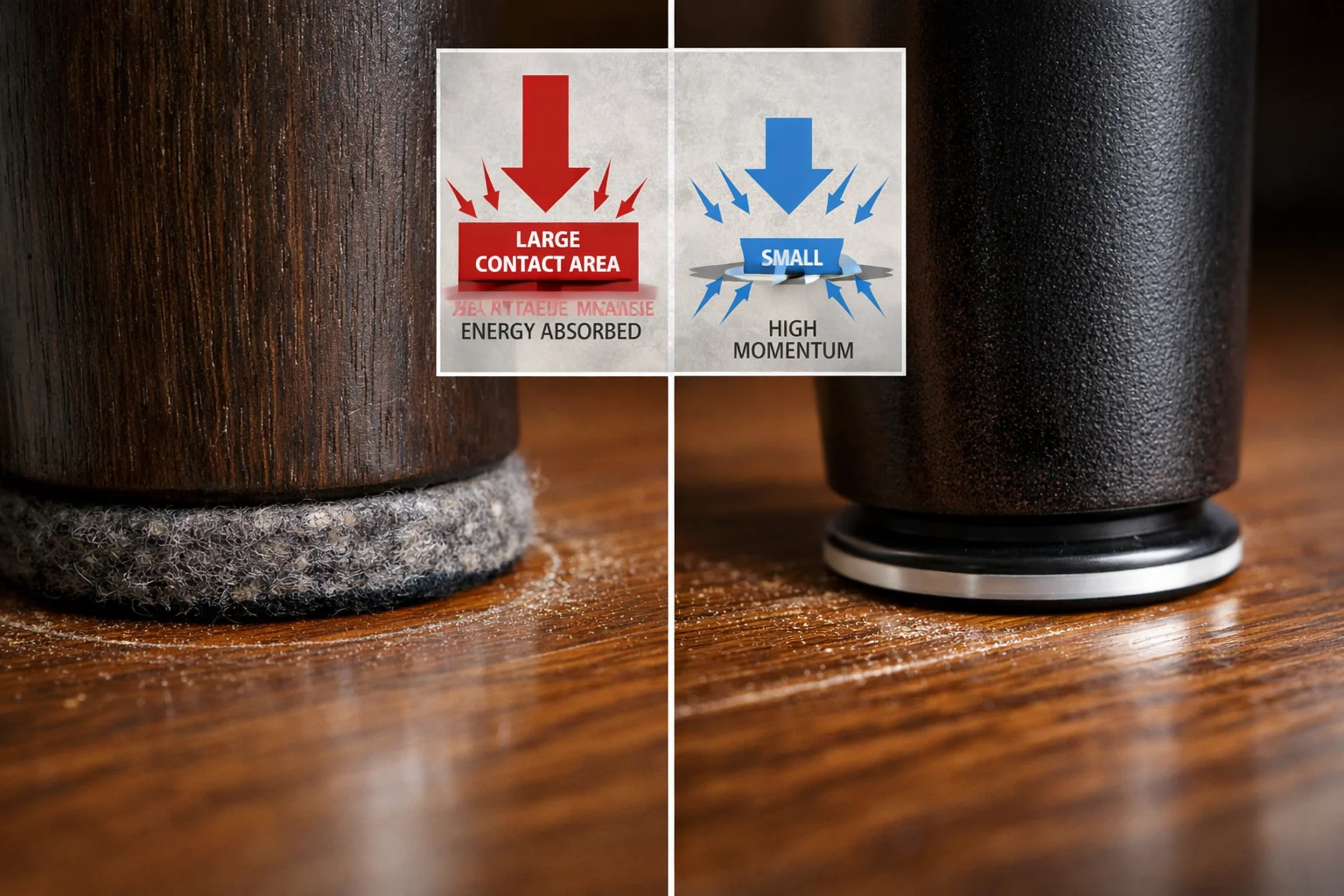
A big reason heavy sofas feel better has nothing to do with luxury branding and everything to do with physics. When you sit down, you are not just adding weight, you are bringing a little burst of speed and impact into the sofa, and the sofa has to deal with that energy without shifting, twisting, or talking back with noises.When the sofa itself has a lot of mass, it soaks up that impact. If you are, say, a 180 pound person dropping into a sofa that weighs around 150 pounds, the sofa has enough inertia that it tends to stay put instead of reacting to you. What you feel is that planted, solid, quiet sensation, like the sofa is part of the room instead of a thing perched on top of the floor.
When the sofa is very light, the opposite happens. Your sit down energy has to go somewhere, and if the sofa does not have the mass to absorb it, the energy gets sent into movement. In a showroom this shows up as a little skid, a little shimmy, or a subtle twist in the frame that makes the whole piece feel flighty, even if the cushions feel nice.
You can test this in about ten seconds. I sit down a bit more firmly than normal, then I stand up, then I sit again, and I pay attention to whether the sofa walks on the floor, shifts sideways, or makes a dry rubbing sound that feels like parts are moving against each other. If I feel any of that, I do not automatically reject the sofa, but I treat it as a sign that the frame and support system have to be excellent, because the sofa is not getting any free stability from mass.
I also do a one hand brace check. I place my hand on the arm or the back while I sit, and I see whether that part of the sofa moves independently of the seat. If the arm flexes, or the back gives and then rebounds, that is often the beginning of the long term story where the frame slowly racks out of square and the sofa starts to creak when you shift your weight.
There is one caveat I keep in mind so I do not fool myself. A light sofa on a slick showroom floor can skid even if it is well built, and a heavy sofa on thick carpet can feel planted even if it is hiding a weak frame. So I try to separate sliding from twisting by watching the seams and the corners. If the whole sofa slides as one unit, that is less concerning than if one corner seems to lag behind the others, which is the tell that the frame is flexing.
What I take from this section is simple. Weight is not proof of quality, but inertia is real, and it affects how a sofa feels every single day. If you want that quiet, anchored feel, you should bias toward a heavier piece, or at least demand stronger construction cues from a lighter one before you let comfort and fabric talk you into it.
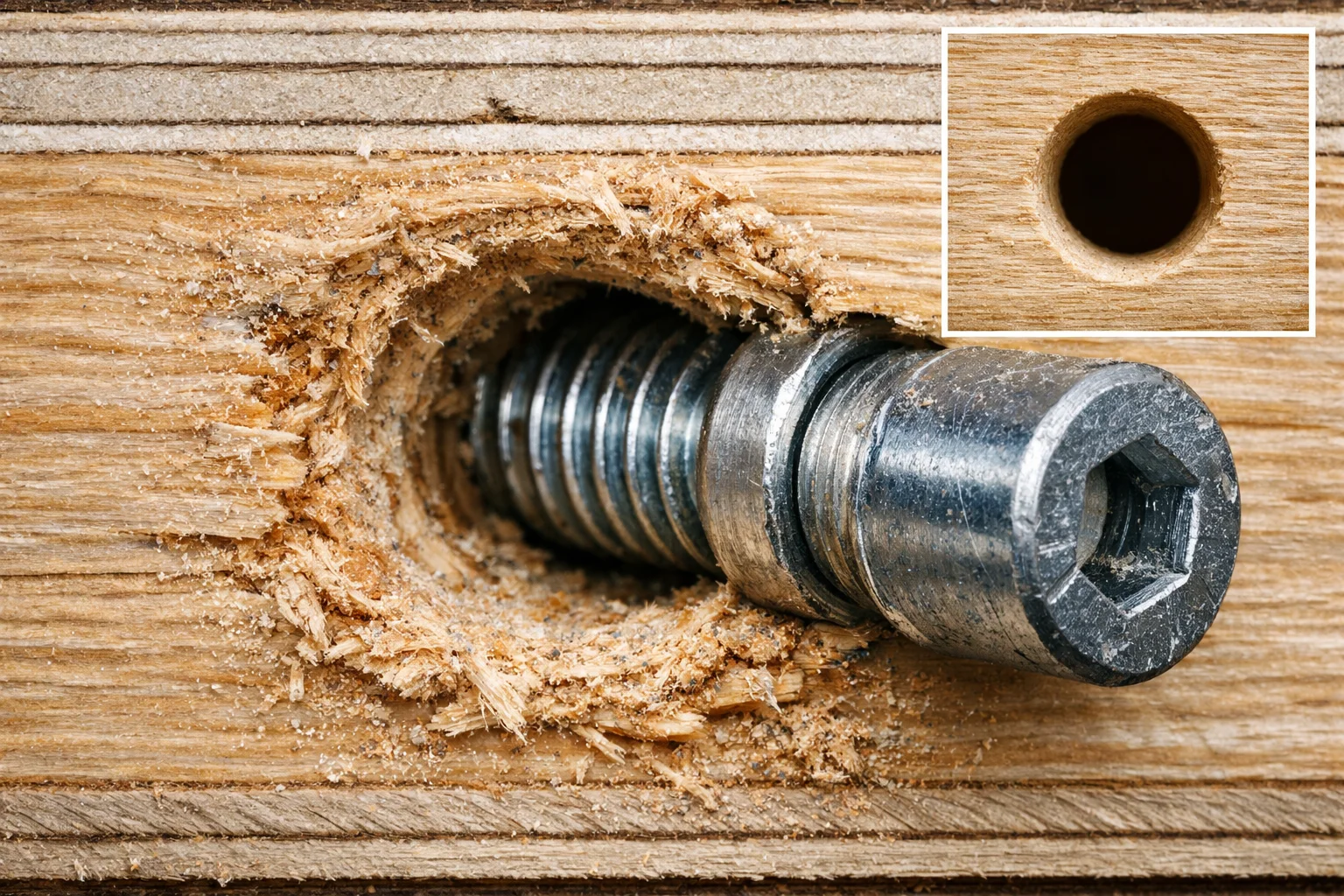
When you see knock down construction, meaning a sofa that comes apart with bolts so it can ship flat or squeeze through tight spaces, I want you to think about what happens the fifth time it is assembled, not the first. Bolts are not the problem by themselves, the problem is the wood around the bolt.
In real life, each move and each retightening can slightly crush the wood fibers under the washer and along the bolt path. Over time the hole can slowly become less round, the bolt stops pulling the joint as tight as it used to, and you get that familiar story where the sofa feels fine until you shift your weight and it answers back with a click or a creak.
In a showroom, I try to confirm whether I am looking at a true KD frame or just removable legs. I ask directly, “Does the frame break down, or is it only the legs,” because removable legs are usually low risk, while full knock down side panels and rails put a lot more stress on those bolt joints.
If the salesperson will let you, I look underneath and I look for the hardware style. I feel better when I see metal to metal capture points, like a bracket that the bolt clamps together, because the joint can stay tight without relying entirely on wood compression. If what I see is a bolt head and washer biting straight into wood, I assume that joint will get looser with repeated moves unless the frame material is very dense and the hardware is oversized.
Then I do a quick “racking” test that mimics what loosening feels like later. I plant one hand on the arm and one hand on the opposite back corner and I give a firm, controlled twist, not jerking, just loading it. If I feel a tiny delay, a tick, or a shifting sensation before it resists, I take that as a sign the joints are already living on friction, not true locked in squareness.
If you know you will move this sofa more than once or twice, I would rather you buy a design that expects that reality. I ask whether the maker sells replacement hardware kits, and whether the company has guidance for retightening after a move, because the brands that plan for repeated assembly usually build in better brackets, better access, and less wood crushing.
If you are mostly settled and you just need the sofa to get through one tricky doorway on day one, KD can still be a smart compromise. I just want you to treat it like any other tradeoff, you gain access and transportability, and you pay for it in long term joint stability unless the construction is clearly designed to prevent the wood around the bolt from slowly giving up.
Technical Comparison
When I say a sofa is built for handling stress, I mean it is built to survive getting shipped, carried, squeezed through doors, and sometimes assembled and disassembled without exploding. When I say a sofa is built for usage stress, I mean it is built to take thousands of sit downs, naps, kids flopping, and people perching on arms, while staying square and quiet.
In a showroom, you can usually tell which philosophy you are looking at by asking one question and watching how they answer. I ask, “Is this frame meant to be taken apart again, or is it built like a permanent box?” If they describe a glued, screwed, and dowelled frame that is not meant to come apart, I treat that as a sign the maker prioritized long term usage stress.
If they describe a knock down design, I immediately switch my thinking to life after a few moves. I assume that every disassembly and retightening steals a tiny bit of tightness, because wood fibers compress, holes slowly lose their crisp shape, and the joint starts depending on friction instead of a true locked fit.
You can pressure test this idea without tools. I sit in the same spot near a front corner, then I shift my hips side to side a few times while keeping my feet planted, and I listen for faint ticks or rubbing sounds. If the sofa answers back when I do a gentle shift, I assume it will be noisier once it has been moved and retightened a couple of times.
If you know you are going to move three or four times, I want you to be honest about the cost of that convenience. A KD sofa can still be the right choice, but only if it feels dead tight when you twist it and the hardware looks like it is designed to clamp securely without chewing into wood.
Now I want to translate the materials into things you can actually verify in a showroom, because you will almost never get a full spec sheet, and even when you do, it is easy to get lost in numbers.
On frames, what I care about is not the species name on the tag, it is whether the structure behaves like solid lumber or like thinner panels doing the job with less mass. If you can see the frame from underneath, I look for wide, confident rails, solid corner blocking, and joints that look like they were meant to stay put for decades, not just pass a shipping test.
When a salesperson says “hardwood frame,” I ask what parts are actually hardwood and what parts are not. I have seen plenty of sofas where the only hardwood is a small strip somewhere, and the rest is softer wood or panel stock, which can be fine, but it changes how picky you should be about wobble, squeaks, and long term racking.
On the support system under the cushions, I treat steel springs and elastic webbing as two very different bets. With sinuous steel springs, I press down hard with my palm in the middle of a seat bay, then I press near the front edge, and I pay attention to whether the resistance feels consistent and whether I hear any metallic pinging or snapping sounds.
With webbing, I do something slightly different. I press and hold for a couple seconds, then release and watch how quickly it rebounds, because cheap webbing can feel supportive for five minutes and then take a set, which turns into hammocking later.
You can also use your ears here. If you hear a dry creak from underneath when you press down, that often means the webbing staples, spring clips, or frame members are already moving against each other, and that is rarely a problem that improves with time.
Foam is the hardest thing to judge quickly, but I still try, because foam is where “feels great today” often becomes “why is this flat already.” I do a slow press with my thumb on the seat cushion, hold it down for a moment, then release and watch whether it springs back cleanly or whether it recovers lazily and leaves a temporary crater.
Then I do the unglamorous test that has saved me more regret than any fabric swatch. I sit in the exact same spot for a few minutes while I talk, then I stand up and look at the cushion shape from the side. If it looks visibly collapsed right away, I assume it will look worse in six months.
If the cushion is reversible, I check that too, because being able to flip and rotate cushions is one of the simplest ways to slow down uneven wear. If it is not reversible, I get stricter about how resilient it feels, because you will live with whatever body impression it develops.
Legs sound cosmetic, but they are part of the stability story. I grab a leg and try to wiggle it gently, and I also nudge the sofa sideways while watching the leg joint. If I see the leg flex independently, or I see the mounting plate shift, I assume that connection will loosen and turn into wobble, especially if you have hard floors and the sofa gets bumped during cleaning.
If the legs are removable, I ask what they screw into. I feel better when the leg threads into a substantial metal plate or insert that is firmly anchored, and I get wary when it is just a wood screw biting into a softer block, because that is the kind of connection that can strip or loosen if the sofa gets dragged.
The simplest way I can sum this section up is that lighter designs usually need better hardware and tighter engineering to stay quiet, and heavier designs usually buy you forgiveness through mass and more substantial parts. If you are buying light, I want you to demand that it feels locked together when you twist it and that it stays silent when you press and shift, because those are the early tells of whether it will still feel like one solid object after real life gets to it.
When you look at that image, I want you to stop thinking “heavy equals good” and “light equals bad,” and start thinking “where is the stiffness coming from.” The heavy frame is basically betting on big chunks of wood staying square through sheer bulk, while the light frame is betting on engineered panels and smarter joints staying rigid without needing as much mass.
In a showroom, you cannot see a clean cross section like this, so I try to infer which logic I am buying by looking underneath and by feeling how the sofa reacts when I load it. If the sofa is heavy, I expect to see thicker rails, chunkier corners, and joints that look like they have a lot of wood behind them, not spindly members that are just along for the ride.
If the sofa is light, I actually get more demanding about the “box” acting like one piece. I do the corner lift again, but this time I watch the opposite front leg and the seam lines along the base, because a good light frame tends to lift as a unit, and a bad one lifts with a little lag, a little twist, or a tiny scissor motion that tells me the rectangle is trying to turn into a parallelogram.
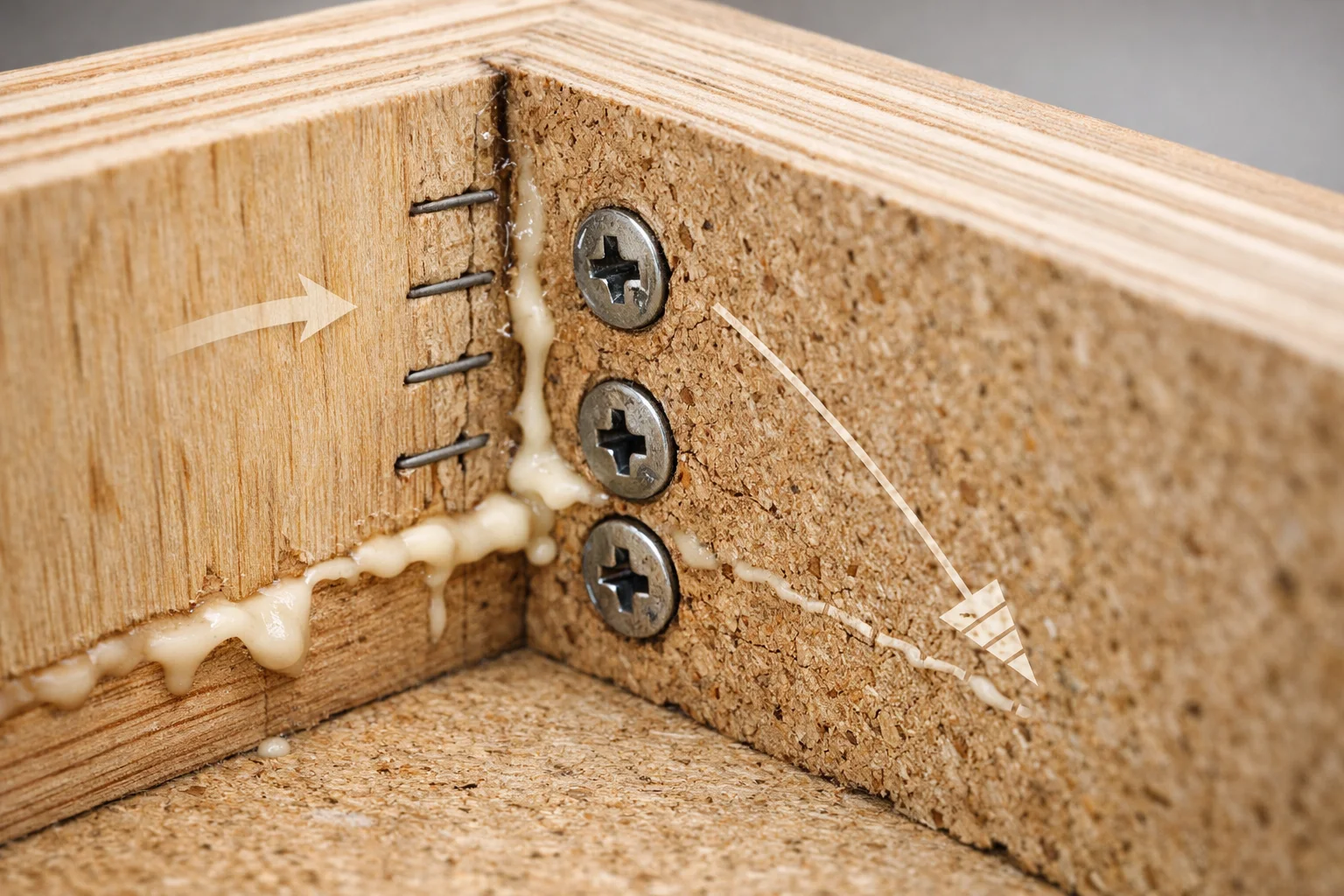
The practical thing you can check for panel construction is the look of the exposed edges underneath. Solid lumber often shows clear grain running in one direction, while plywood edges show thin stacked layers, and neither is automatically better, but plywood only helps you when it is used in larger, well-joined pieces. If I see thin, narrow strips of “wood” everywhere, especially if they are stapled together, I assume it is lightness achieved by cheapness, not lightness achieved by engineering.
Joints matter more than the material label, so I look for signs that corners are reinforced in a way that spreads stress out. If you can see corner blocking, gussets, or brackets that connect parts over a wide area, I relax a bit. If the corners look like two sticks meeting with minimal reinforcement, I assume that is where the creaks will be born once the sofa has been sat on for a year.
I also pay attention to how the sofa sounds during the twist test, because sound is often the first symptom of a joint that is depending on friction. A heavy frame can be quiet even if it is a little crude, just because it is hard to make big wood move. A light frame has to be genuinely tight, and if it makes a dry chirp or a click in a showroom, I take that seriously, because homes are drier, moves are rougher, and time only adds clearance.
If you are trying to decide between a heavy and a light build, this is the question I ask myself: do I want forgiveness, or do I want efficiency. Forgiveness is the heavy frame that stays calm even when life is messy. Efficiency is the light frame that can be excellent, but only if it behaves like a rigid box when you lift, twist, and sit, and only if it stays silent while doing it.
The "MDF Weight" Trap
Beware of sofas that feel heavy but use low end materials.The trick is that some manufacturers add Medium Density Fiberboard, or even particleboard, in big panels so the sofa feels substantial when you lift a corner. You pick it up and think, this must be sturdy, but what you are feeling is often just dead weight from pressed sawdust.
The technical failure is that MDF is heavy without being strong in the ways a sofa needs. It can slowly crush and sag under its own weight, and once it starts to deform, joints loosen and the seat can develop that permanent tired dip even if the cushions are still decent. A good heavy sofa usually gets its weight from solid hardwood and thicker structural parts, while a bad heavy sofa gets its weight from large, weak boards that do not like screws, staples, or repeated stress.
In a showroom, I treat “mysteriously heavy” as a prompt to look underneath, not as a green light. If the salesperson says the frame is “engineered wood,” I ask what that means here, because that phrase can cover good plywood parts or it can be MDF in places that matter.
The fastest tell I use is to look at any exposed cut edge on the underside. If I see a fuzzy, uniform brown core with no visible layers and no grain, I assume MDF. If I see larger wood grain, it is more likely solid lumber, and if I see thin stacked layers, it is plywood, which I usually prefer over MDF for structural parts because it tends to hold fasteners better and resist sagging better.
Then I focus on where the weight is coming from. I am much less worried about MDF in non structural cosmetic panels, like a thin dust cover backing or a decorative skirt board, and I get much more worried when I see big MDF panels acting as long rails, seat platforms, or anything that takes bending load between legs.
You can also learn a lot by doing a “fastener reality check” with your eyes. I look for places where screws go into the frame, like leg mounts, spring clips, or brackets, and I ask myself whether those screws are biting into real wood or into a compressed board that can strip. If I see a lot of staples and very few real brackets or blocks around stress points, I assume the material underneath is not something the builder trusts with screws.
I also do a simple sound and flex test that MDF heavy sofas often fail. I press down hard near the front edge of the seat, then I press down again closer to the middle, and I listen for a crunchy, papery creak. That specific sound, especially if it comes with a tiny delayed give, is often panel material and staples shifting, not a spring system doing its job.
If you like a sofa that might be using MDF, you do not have to walk away automatically, but I would tighten your standards. I would only proceed if the sofa stays dead quiet under shifting weight, if the corners do not rack when you twist it, and if the leg mounts and support system look like they are anchored into solid wood blocks or metal plates rather than directly into board.
When I am stuck choosing between two sofas that feel similarly comfortable, I use this as my tie breaker. I would rather buy a sofa that feels a little less “impressively heavy” in the showroom, but shows me honest structure underneath, than one that feels like a tank because it is carrying around heavy board that will not stay crisp and square once it has lived through a couple of heating seasons and daily sitting.
Buyer's Use-Case Matrix
I stop trying to find one perfect sofa the moment I know how you live with it, because the same construction choice can be smart for one person and a regret for another. What I do instead is match the sofa’s build style to your moving reality, because moves are where frames get racked, joints get shocked, and “fine for daily sitting” turns into “why is this loose now.”If you are a Nomad and you expect to move every year or two, I would bias you toward a lightweight modular or at least a sofa that can be handled without dragging and twisting it. In the showroom, I would still do the corner lift and twist tests, but I would add one more practical check, I would ask you to look for plywood used as real structure, not just thin skins, because good plywood tends to resist that out of square racking that happens when movers grab an arm and a base rail and heave.
When a salesperson says “solid wood frame” for a sofa you will move often, I do not automatically celebrate, because solid lumber can split at fasteners and joints when it gets jolted and torqued through doorways. Plywood is not a luxury word, but in my experience it is often the more forgiving choice for repeated moves, as long as the sofa still feels like one rigid box when you load it and it stays quiet when you shift.
If you are a Settler and you own your place, or you just know this sofa is going to sit in one room for a decade, I push you toward a heavyweight uni body sofa that is not designed to come apart. In a showroom, that means I want to feel that planted inertia when you sit down, and I want the arms and back to feel like they are part of the same object, not attached parts that flex, because over ten to fifteen years it is the slow working of joints that usually turns into noise and wobble.
For you, weight is not about impressing you on day one, it is about joint longevity, because a heavier, simpler box that never gets disassembled has fewer opportunities to loosen. I still want you to look underneath for corner reinforcement and confident rails, but I am generally looking for boring permanence, not clever portability.
Then there is what I think of as the Third Way, which is a lightweight sofa that uses a steel frame or at least metal to metal connection points so it can be taken apart and reassembled many times without slowly chewing up wood. If you are the kind of person who moves but hates the idea of a sofa getting sloppier with each move, I would have you ask specifically whether the main structural connections are metal to metal, and whether the bolts clamp brackets rather than crushing wood, because that one detail is often the difference between “tight forever” and “tight until the holes ovalize.”
In the showroom, the fastest way I check whether this Third Way is real is that I look for capture brackets and repeatable alignment, and then I do the twist test and listen for any ticking right away. If a sofa is selling you the idea of infinite reassembly, I want it to behave dead tight even when you load it off axis, because the whole point of metal hardware is that it should not be relying on wood fibers to stay crisp.