Questions to Ask Salespeople: Interrogating the Specifications
Introduction
I used to think I could judge a sofa the same way I judge a jacket, by looking at the stitching, feeling the fabric, and giving it a quick sit. After a few “nice looking” sofas turned into saggy hammocks, I learned the uncomfortable truth that most of what matters is buried where you cannot see it.
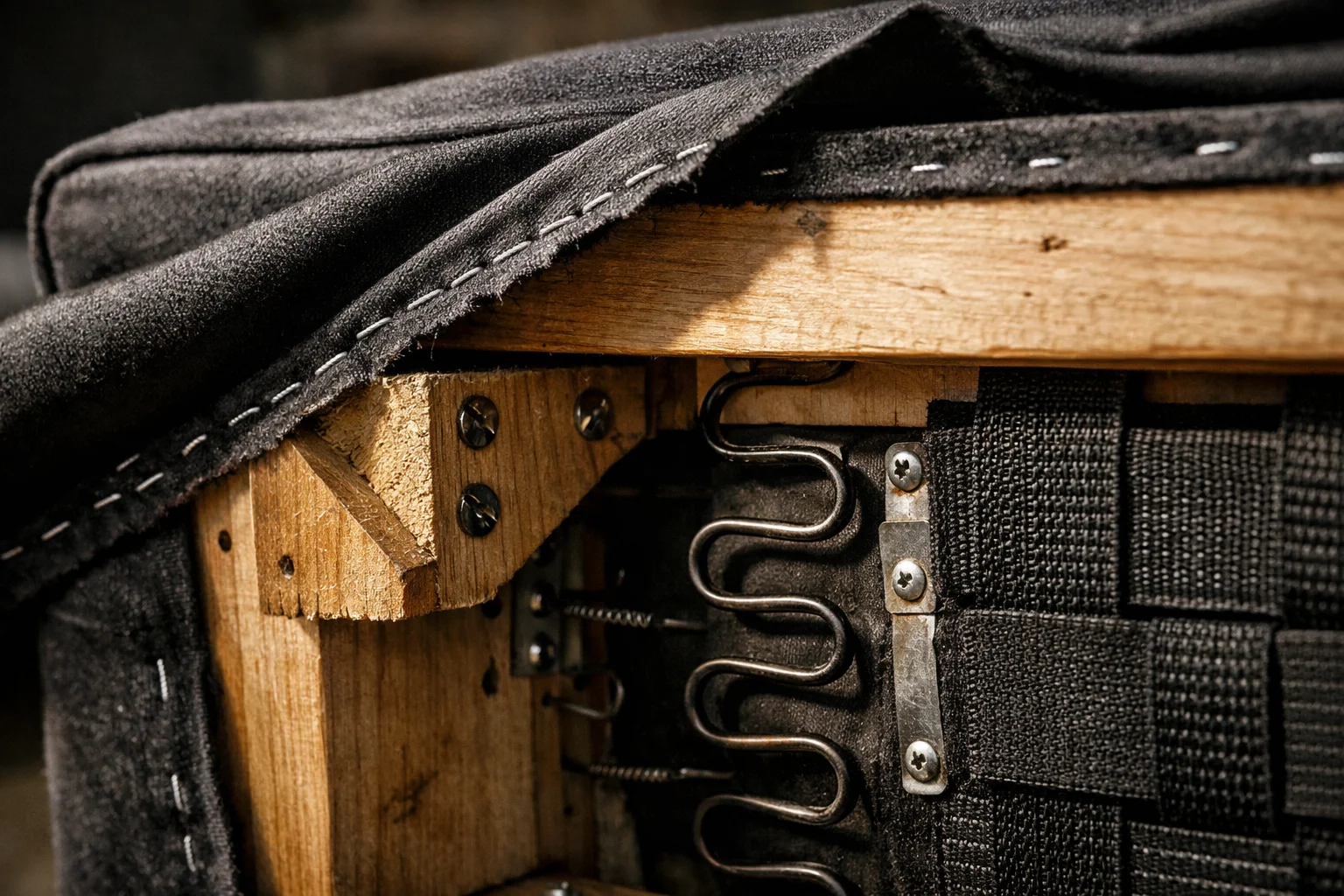
A sofa is basically a sealed box. The frame, the joinery, the springs, and the support system are the engine, and the manufacturer usually hides that engine under foam, fabric, and a dust cover that is stapled tight to the bottom. On a showroom floor, you can be staring right at failure points and have no idea, because the pretty upholstery is doing its job, it is distracting you.
So I stopped trying to inspect sofas only with my eyes. In a store, I treat a sofa like a closed cooler, you do not know what is inside until you open it or you push it hard enough to learn how it is built.
When I say you have to inspect the sofa with your mouth, I mean you have to use your words. You have to ask direct questions that force the salesperson to describe what is under the fabric, and you have to ask them in a way that makes vague answers feel uncomfortable. If you do not ask, you are agreeing to buy the mystery version.
I also mean you should be willing to pause the whole shopping vibe and turn it into an interview. If the salesperson cannot tell you what the frame is made from, how the corners are joined, what the seat support is, and what the cushion core is, then I assume the brand is relying on you not knowing to keep the conversation on colors and “comfort.”
In this guide, I am going to keep bringing you back to the same goal: getting the hidden stuff out into the open. When you cannot see inside a sofa, your advantage is that you can still make them tell you what is inside, and you can still use your hands and your body weight to test whether those claims make sense.
The "Lifestyle" Distraction
Sales training emphasizes "lifestyle conversations" (e.g., "How does this fabric match your drapes?"). This is a distraction. Your goal is to pivot from being a customer to be charmed, to an auditor to be satisfied.When a salesperson starts steering you into décor talk, I treat it like a detour. Color and “does it go with the room” matters, but it is the easiest part to change later, and it is the part that sells sofas that do not last.
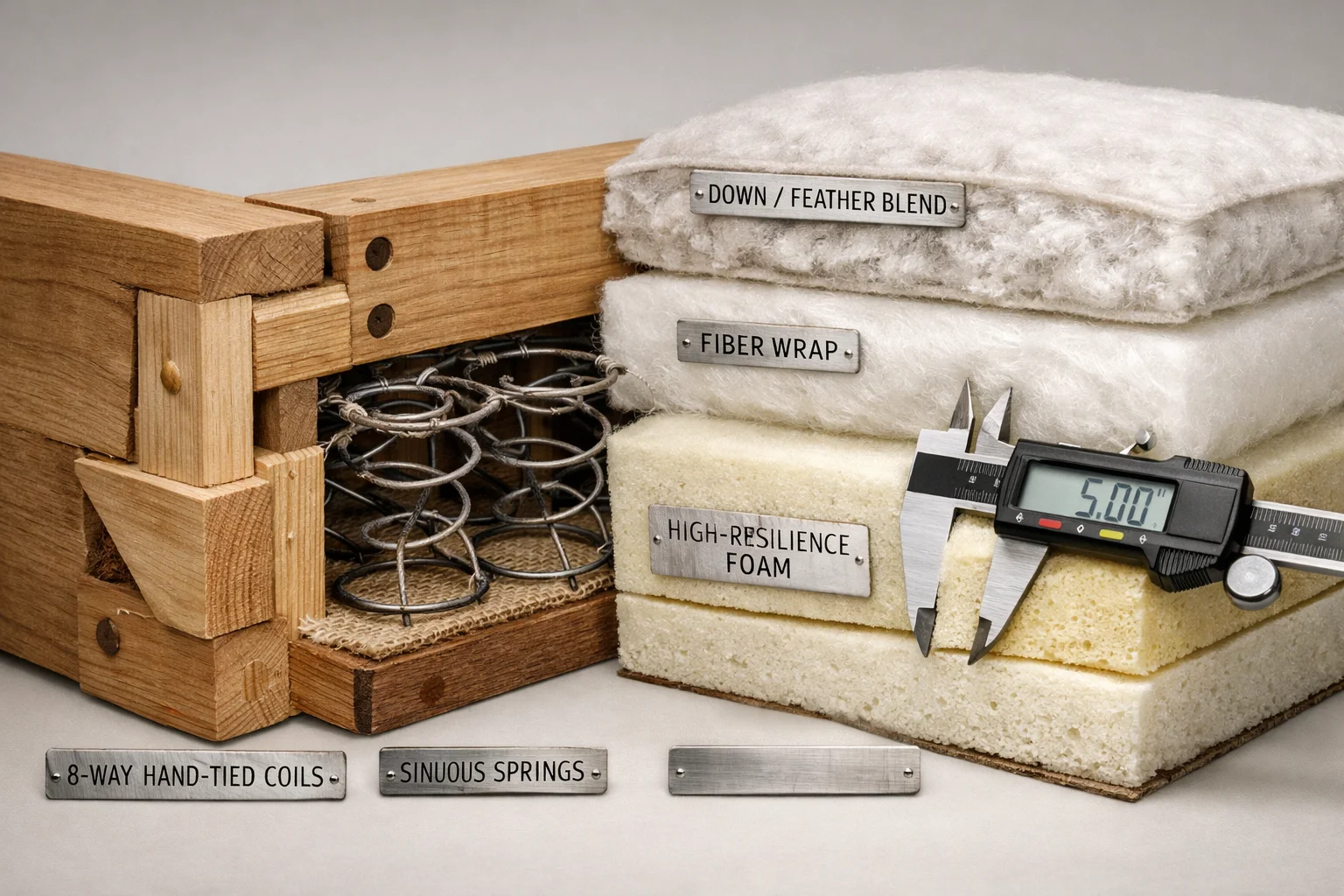
What I do in that moment is politely answer in one sentence, then immediately ask a construction question that cannot be answered with vibes. If you say, “I want something that works with a neutral palette,” then you follow it with, “Before we pick fabric, what is the seat support under the cushions, and is it sinuous wire, webbing, or eight way hand tied springs?” You are not being difficult, you are setting the agenda.
If they keep pulling you back to “how you live,” I make them define it in mechanical terms. When someone says, “This is great for a busy household,” I ask, “What exactly makes it hold up, is the cushion core high density foam, a foam and fiber wrap, or down blend, and can you show me that in writing on the spec sheet?” Lifestyle claims are marketing unless they connect to a material, a method, and a document.
You can also use lifestyle questions against the distraction, because your real lifestyle is wear and load. If you have kids, pets, or you sprawl, that is not a fabric conversation first, it is a support and cushion conversation first. I will literally say, “We sit here every night, same two spots, so I’m trying to avoid early sagging, what in this build prevents that?” Then I go quiet and let them fill the silence.
The fastest way to break the spell is to ask for proof you can touch. I ask to see the cushion tag or insert label, and I ask if the cushions unzip so I can feel the core and the wrap rather than just squeezing the outside. If they cannot unzip, cannot show a spec sheet, and cannot name the materials confidently, I assume I am being sold the story, not the sofa.
If you feel yourself getting charmed, reset by switching from “What do you think looks nice?” to “What is this made of, and how is it put together?” I have walked out of stores after realizing every answer was a gentle pivot back to fabric books and throw pillows. If they will not stay with you in the unglamorous details, they are telling you where the risk is.
Section 1: The Core Physics Questions
These are the questions I ask first because they reveal whether the hidden materials are even capable of daily use. If the salesperson can answer them clearly and show you something in writing, you are probably not looking at a “mystery build.” If they cannot, I assume the sofa is built to feel good for a few months, not to hold up for years.
”What is the foam density in pounds per cubic foot?”
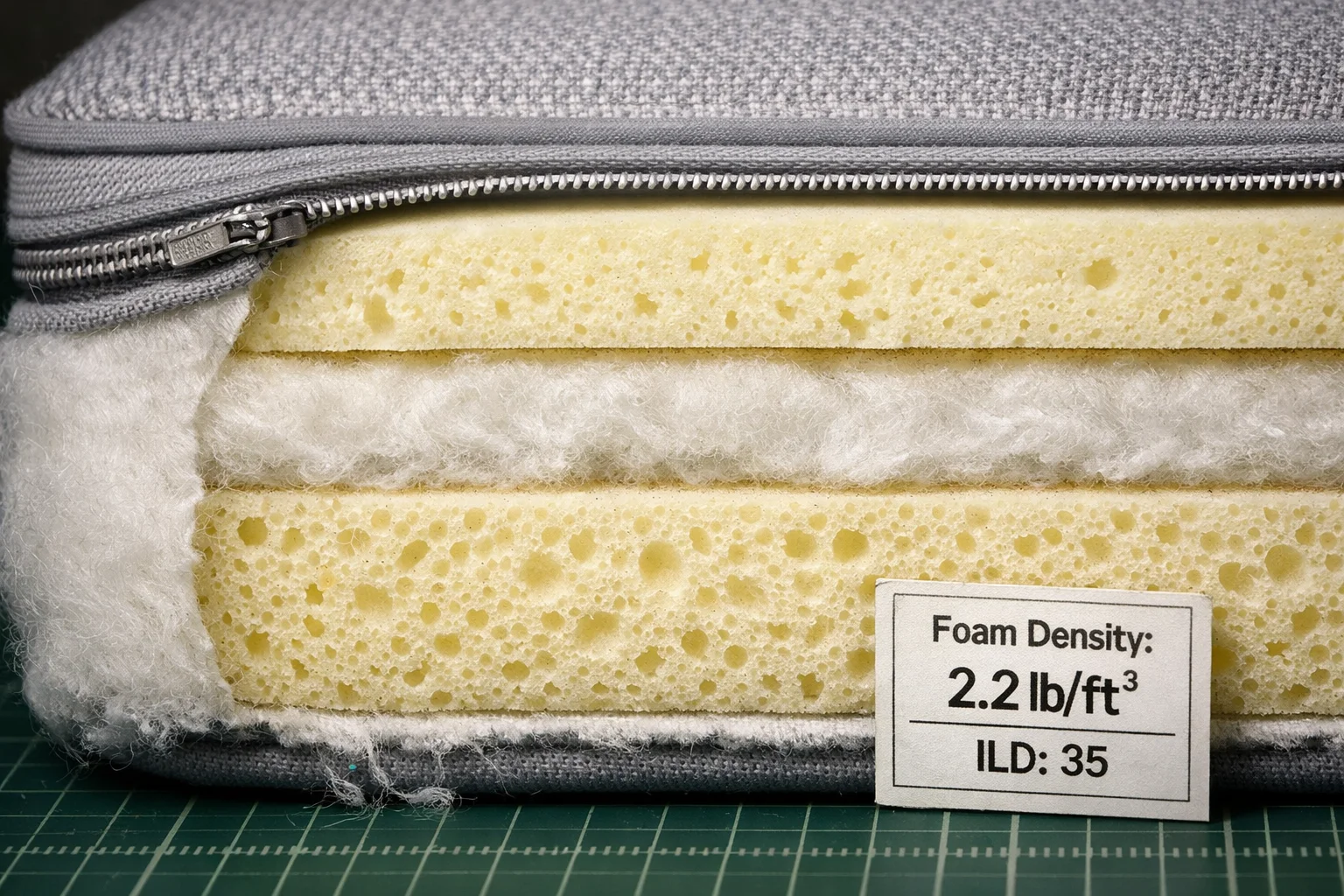
I ask this exactly like that, because it forces a measurable answer. When I hear “high density,” “premium,” or “medium firm,” I treat it as a non answer, because those are comfort words, not material specs.
What you want to hear is a number tied to the seat cores, not the back pillows. If they say the seat foam is 1.8 pound density, I consider that a workable minimum for a regular household. If they can say 2.5 pound density for the seat cores, I take that as a strong sign the cushions are built for longer term use, not just showroom comfort.
If you ask for foam density and they stare at you, guess, or try to redirect you to “feel it,” I read that as a warning. In my experience, that is often where you find the cheaper promotional grade foam that looks fine early on, then collapses into the two permanent butt dents that make the whole sofa feel tired.
In a showroom, I also like to pair the question with a physical check. I ask if the seat cushions unzip, and if they do, I open one and look for a tag on the insert, then I squeeze and pinch the foam itself, not just the outer wrap. If it feels airy, overly squishy, or like it rebounds slowly in a way that seems weak, I do not let “but it’s cozy” talk me into it.
”What is the suspension gauge?”
After the foam, I go straight to what is holding you up, because this is where sagging starts. Most modern sofas use sinuous springs, and that is not automatically bad, but the gauge matters because it tells you how much steel is actually there.
What I want to hear is 8 gauge steel for the sinuous springs. If they tell you 11 gauge, I treat that as too thin for a sofa that is going to see nightly use, especially if you tend to sit in the same spot or you have a household that flops down hard.
If they say it is “standard webbing,” I slow down and get very skeptical. Webbing can be done well in some applications, but I have seen too many cases where it stretches out, dries out, or just gives up, and you end up feeling the frame through the seat long before you should.
If the salesperson does not know the gauge, I ask them to show me the spec sheet or the manufacturer’s build description. If there is no documentation available at all, I assume the store is asking you to buy the seat support on faith, and I have learned not to do that.
The "Drop-In" Trap
When someone tells you a sofa is “hand tied,” I do not let that float by without verification, because the phrase gets used loosely. True eight way hand tied seating uses individual coils that are tied with twine by a person, and it is usually something a brand is proud to document.If the support system is a metal grid unit that drops into the frame as one piece, I treat it as a machine made assembly, not hand tied craftsmanship. If you cannot see it in the showroom, I ask for a cutaway photo, a build diagram, or a written description from the manufacturer that explains exactly what is inside.
Section 2: The Structural Audit
This is the part where I stop treating the sofa like a comfy object and start treating it like a piece of furniture that will get dragged, scooted, and loaded the same way for years. The goal here is to identify the weak links that do not show up in a five minute sit.
”Are the legs integral or screw-in?”
I ask this because the legs are not just decoration, they are leverage points. Every time you drag the sofa a little to vacuum, or a kid flops onto the arm and the whole thing twists, those forces travel through the legs into the frame.
What I want, especially for the rear legs, is that they are integral to the frame. That means the rear leg is basically part of the main frame rail, carved or built as one continuous piece, so the stress is carried by solid wood instead of by a bolt. When a salesperson says “integral,” I follow up with, “So the rear legs are actually part of the side frame, not a separate piece that threads in?” and I listen for a confident yes.
Screw in legs are not automatically a deal breaker if you truly never move the sofa, but I treat them as a risk multiplier because they loosen over time. The failure mode I have seen is not subtle, the leg starts to wobble, then the bolt chews the wood or the hanger hardware, and one day it shears or rips out when the sofa gets dragged even a few inches.
In the showroom, I do a simple check that does not require tools or being rude. I crouch down and look where the leg meets the frame, and I try to gently wiggle the leg side to side with one hand while the other hand presses down on the seat or arm to add a bit of load. If I feel any clicking, shifting, or movement at that joint on a brand new floor model, I assume it will only get worse at home.
If the salesperson tells you the legs are removable “for delivery,” I do not let that be the end of the conversation. I ask whether only the front legs come off, or whether all legs are screw in, and I ask what the actual attachment is, meaning a threaded bolt into a plate, or a true integrated wood structure with a cosmetic foot.
”Can I see the cutaway model?”
This question is my shortcut for finding out whether a brand is proud of its skeleton or trying to keep you focused on the upholstery. When a company builds with real joinery, like dowels, corner blocks, and substantial rails, they often have a cutaway on the floor or at least photos and diagrams they can show you without squirming.
If there is a cutaway, I look for wood to wood joints that are reinforced, not just butted together. I also look for corner blocks in the frame corners, because those are the places that rack and loosen when you sit on an arm or when the sofa gets bumped around. If the salesperson points to staples like they are a feature, or if what you see looks like thin bits of wood with a lot of fasteners doing the work, I mentally downgrade the entire sofa no matter how good the fabric feels.
If they do not have a cutaway, I ask for any internal documentation they can provide. A good answer sounds like, “Yes, here is the build sheet, here is the frame material, here is the joinery method, and here is how the corners are blocked.” A bad answer sounds like, “Nobody asks that,” followed by a hard pivot back to colors.
When a brand refuses to show internals or cannot describe them beyond vague reassurance, I assume the hidden story is staples, minimal blocking, and sometimes even filler materials that have no business being structural. I am not trying to be cynical, I am trying to avoid paying for a pretty cover over a weak box.

The key is that you are not asking to be difficult, you are asking because the sofa will live a hard, repetitive life. If they cannot show you how the hard parts are built, I treat that as information, and I move on before I get attached to the throw pillows.
Section 3: The Longevity Questions
This is where I stop asking, “Is it good today?” and start asking, “What wears out first, and how do I slow that down?” A sofa usually fails in predictable places, the fabric pills or thins where your body rubs it, and the seat develops two permanent craters where you always land.
5. “What is the Double Rub Count?”
When I hear “performance fabric,” I do not assume it means durable, I assume it means stain resistant or easy to clean. Durability is a separate question, and the simplest common metric you can actually request is the double rub count, usually measured in Wyzenbeek cycles.
In plain terms, a higher number means the fabric is less likely to wear through from friction, like sliding in and out of the same seat every day. For a normal living room, I am comfortable when the fabric is in the rough range of fifteen thousand to thirty thousand double rubs, as long as the rest of the sofa is not a weak build.
If you have kids, pets, jeans rivets, or you know you are hard on furniture, I personally push for fifty thousand plus. If someone is pitching you on a sofa as “family friendly,” and the fabric is down near the residential minimum, I treat that as a mismatch between the story and the spec.
Commercial grades around one hundred thousand and up can be a good sign, but I have learned not to treat it like an automatic win. Some very high rub fabrics can feel stiff or “plasticky,” so I use it as a screening tool, then I still touch the fabric and picture living with it.
In the showroom, I ask for the exact number and I ask where it is documented, meaning on the swatch tag, the spec sheet, or the manufacturer’s website page for that fabric. If the salesperson cannot give you a number anywhere in writing, I treat “durable” as a guess, and I keep shopping.
6. “Are the cushions flippable?”
If you want one simple feature that tends to correlate with longer sofa life, it is this. I want seat cushions that you can flip and rotate, because most people sit in the same two spots, and a cushion that only ever gets used on one face is basically guaranteed to show wear faster.
When the seat cushions are sewn to the frame, or when the bottom side is made from a cheap lining fabric that is not meant to be seen or sat on, you lose half your usable wear surface right away. In my experience that is not a small downside, it is one of the most common ways a sofa looks “old” early even if the foam is decent.
What I do in the store is ask you-can-do-it-right-now questions. I ask whether the seat cushions are loose, whether they unzip, and whether they are the same fabric on both sides. Then I physically lift one, turn it over, and check if it is truly meant to be used both ways, or if the underside is a thin black cloth that would look awful in a month.
If the salesperson says, “They’re not meant to be flipped,” I ask what the brand expects you to do when the primary seats start to compress, and whether replacement inserts are available and priced reasonably. If the answer is vague, I assume the business plan is that you live with the dents until you replace the sofa.
I also look at the back cushions, because fixed backs can be fine, but only if they are designed to be re stuffed or re shaped easily. If everything is attached and nothing can be rotated, I only buy it if the rest of the build is so strong, and the price is so honest, that I am willing to accept a shorter “looks new” window.
Section 4: The Protection Clauses
This is the part of the purchase where I stop thinking like a shopper and start thinking like someone signing a contract. A sofa warranty is not a warm promise, it is a set of exclusions, and those exclusions often describe the exact ways a sofa actually becomes disappointing.
7. “Does the warranty cover cushion softening?”
I ask this bluntly because cushion softening is the most common “it looked great at first” problem, and it is also the most common thing warranties quietly label as normal. When you hear “lifetime warranty,” you should immediately ask, “Lifetime of what, exactly?” because a lot of the time it means lifetime on the frame only, and only for specific types of breakage.
What I have learned to watch for is the phrase “normal wear and tear,” because that is the bucket they use to toss in cushion flattening, fiber compression, loss of firmness, and fabric fading. If your favorite seat turns into a crater in year three, it can still be considered normal, even if you feel like the sofa failed early.
In the showroom, I ask to see the written warranty, not the brochure summary. Then I scan for the cushion section and I look for any language that promises a remedy for loss of firmness, not just seam failure or a zipper issue.
If the salesperson says, “Cushions are covered,” I make them get specific. I will say, “If the foam softens and the seat sits lower, do you replace the foam insert, do you add topping, do you send someone out, or is that excluded as wear?” If they cannot point to the exact clause that protects you, I assume you have no protection.
I also ask how long the cushion coverage lasts and what you have to do to claim it. Some warranties require photos, receipts, and sometimes inspection, and many are prorated, which means you may get only a partial credit when you need it most.
Even when there is a cushion warranty, I treat it as a last resort, not my plan. My real goal is to buy cushions I can service later, meaning I can unzip them, remove the insert, and replace foam without needing a whole new sofa, because that is the only “warranty” I have actually been able to rely on in real life.
If you want a simple rule I use, it is this. If the warranty does not clearly describe what happens when the seat loses firmness, then “lifetime” is mostly marketing, and you should price the sofa as if you are on your own.
Technical Summary: The Showroom Interrogation Script
I would literally put this in your phone notes and use it word for word. You are trying to get at least a few hard specs, because if they cannot answer these, you are probably buying a mystery build. I ask what the seat foam density is and I look for 1.8 pound density or higher for the seat cores. I ask what the suspension is and if it is sinuous wire I ask whether it is 8 gauge. I ask what the frame is made from and I want kiln dried hardwood, not vague “mixed wood” talk. I ask for the fabric double rub count and I want something that matches your household, with thirty thousand plus as a comfortable baseline for many people. I also ask about serviceability, meaning whether I can unzip the cushions so I can replace the foam later without replacing the whole sofa.Explore Technical Reference
Price vs Quality: Understanding the Law of Diminishing Returns
Why doubling your furniture budget does not double durability. Mapping the value curve and understanding where extra spending stops adding longevity.
Analyze Details →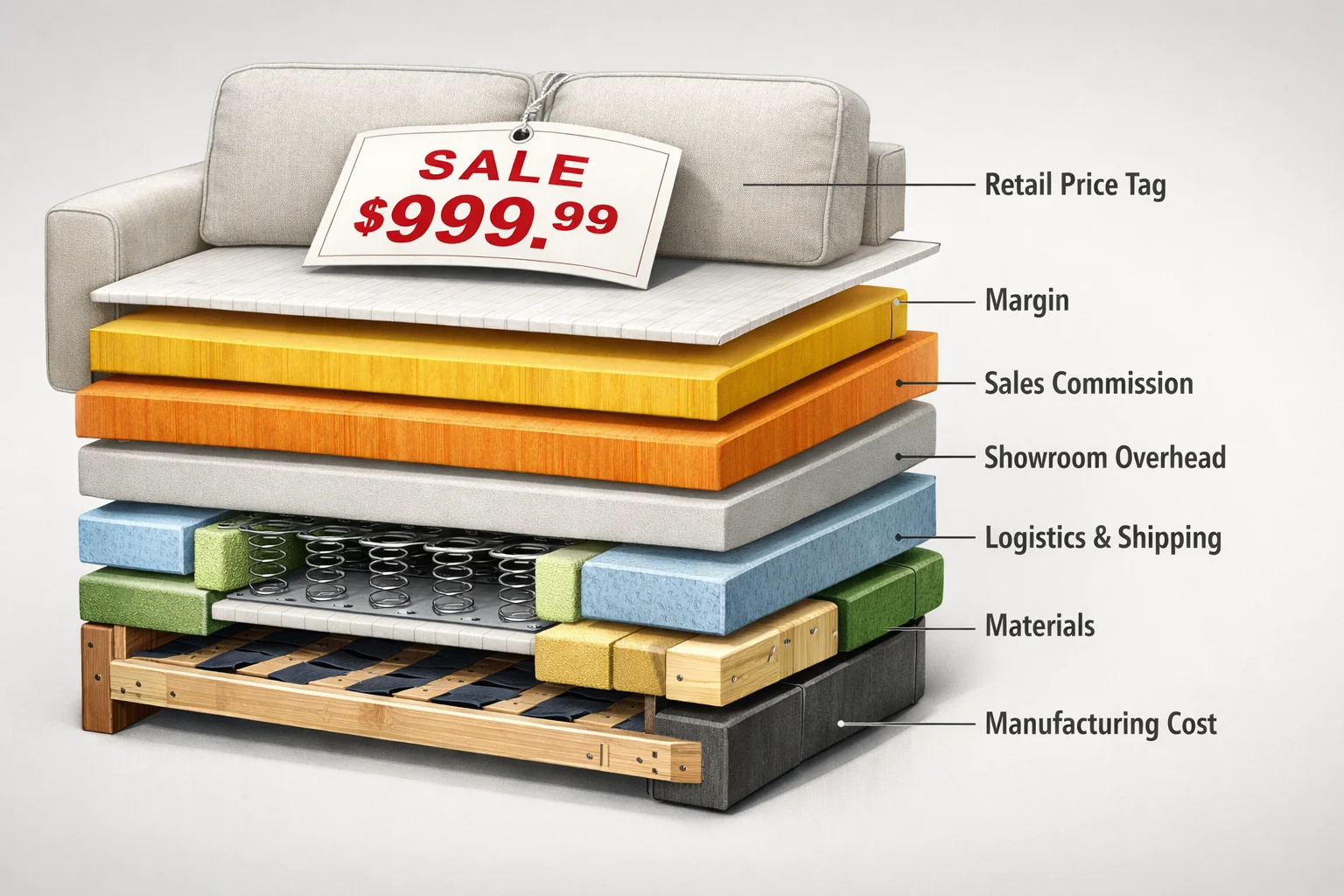
Furniture Negotiation Tactics: Why Sticker Price is Just a Starting Point
Understanding the economics of furniture markup and how to use floor models, bundles, and timing to significantly reduce what you pay.
Analyze Details →